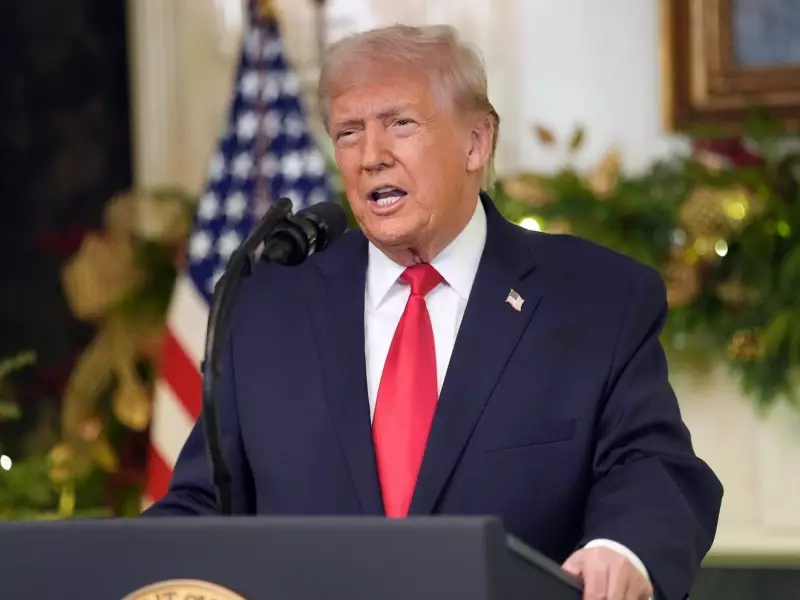
In a year-end address to the nation, President Donald Trump positioned himself as the architect of an impending American economic revival, while launching sharp criticisms at his predecessor, Joe Biden. The speech, delivered live from the White House's Diplomatic Reception Room on Wednesday, December 17, 2025, lasted approximately twenty minutes.
A Vision of Revival and Political Contrasts
Framed by Christmas trees and a portrait of George Washington, Trump outlined his expectations for a "big year ahead" for the United States. He contrasted this optimistic forecast with a grim portrayal of the Biden administration's legacy, which he blamed for making life less affordable for Americans and failing to secure the country's borders.
"This is what the Biden administration allowed to happen to our country," Trump stated, asserting he "inherited a mess" upon taking office and vowing, "I'm fixing it." His address served as a platform to promote his "Make America Great Again" agenda, highlighting his administration's tariff regime, energy policies, and Middle East peace plans.

Promises and Political Headwinds
The president made several key announcements aimed at appealing to voters. He revealed that 1,450,000 military service members would receive a special "Warrior Dividend" cheque for $1,776 before Christmas, a nod to the year 1776. Trump claimed these payments were funded by tariff revenues.
Looking ahead, he promised Americans would benefit from the "largest tax cuts in American history" next year, suggesting "many families" could see annual savings ranging from $11,000 to $20,000.
However, these pledges come against a backdrop of significant political challenges. Recent polling indicates public frustration with Trump's economic management. A Reuters/Ipsos poll cited by Forbes showed the president's approval rating dipping to 39%, with disapproval rising to 59%. Specific approval of his handling of the economy fell to 33%.
Economic Realities and Omissions
While Trump pointed to a rising stock market, lower gasoline prices, and investments in artificial intelligence, economic indicators present a mixed picture. According to The Associated Press, the U.S. inflation rate has re-accelerated, with the consumer price index increasing at an annual rate of 3%, up from 2.3% in April 2025.
The job market has also softened significantly. Since April's "Liberation Day"—when Trump announced import taxes—monthly job gains have averaged only 17,000. The national unemployment rate has climbed from 4% in January to 4.6%.
Notably absent from the speech was any detailed mention of future tariff measures, a topic he has frequently teased over the past year. These policies have had a substantial impact on Canada's economy, leading to repeated announcements of layoffs within the Canadian manufacturing sector.
The address sets the stage for the upcoming political battles of 2026, as the Republican Party seeks to maintain control of Congress in the midterm elections amid declining presidential popularity and persistent public concern over the cost of living.