We should teach people how to protest better. I am glad we have a bubble law for protests, but I am disheartened that it is necessary.
A Personal Encounter with Protest Harassment
A few years ago, one of my children sent me a frantic text message saying a protester was harassing kids at her school. Several thoughts crossed my mind, not all of which I can share in a family newspaper. One of them was: What is wrong with people who protest transgender rights in front of a school?
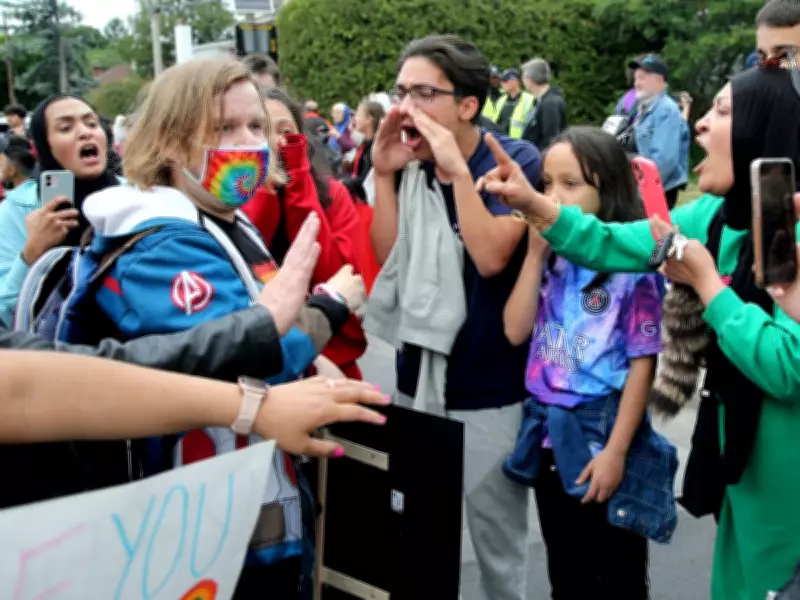
The individual in question, whose name I refuse to mention because I want him to remain as unknown and unrecognized as possible, was standing outside Nepean High School and Broadview Public School with a disgusting billboard containing anti-transgender messaging. My social-justice-oriented teenager was furious on behalf of her transgender and gender-diverse schoolmates. She wanted to confront him.

I told her to go ahead, but not to let him provoke her into hitting him, because that is exactly what he wanted. I jumped on my bike and hurried to join the counter-protest to protect the children from the disruption.
The Incident That Sparked Change
The incident made the news, and I know some of you remember it, not just because I wrote a column about it at the time. Along with anti-vaccine protests at hospitals and the disruptive trucker occupation of our downtown, it was one of the events that led to the City Council vote to implement the Safe Access to Social Infrastructure Bylaw, better known as the bubble bylaw.
Ottawa is not the first city to adopt such a measure. Toronto, Vaughan, and Calgary have already done so. The concern is the same: How do we allow people to protest, as is their right, without infringing on others' equally legitimate rights to access healthcare, places of worship, or schools—especially K-12 students—without having to navigate around billboards?
Mixed Feelings About the Bubble Bylaw
Part of me is happy we are introducing bubble zones, but another part wants to teach protesters to behave so we do not need them. Between these two positions sits a loudmouth writer with a legal background, wondering why we cannot manage to protest without requiring so much adult supervision.
Ottawa's bubble bylaw gives the city the authority to create temporary safe access zones around certain locations, such as schools, hospitals, and community centres, but not government buildings or courts. In these zones, protesting would not be allowed. The bubble would be activated after an application by someone running such a facility, would only be valid during operating hours, and would be limited to a 50-metre radius around the building—the length of an Olympic pool, which legitimately makes it hard to read a sign.
Constitutional Considerations
Otherwise, I believe the bylaw's impact on our constitutional right to free expression is mild. Whether courts will agree with me on this point remains to be seen. There is precedent for such measures, starting with British Columbia, where bubble zones around abortion clinics were upheld in the 1990s and then extended across the country. Municipal bubble bylaws have not yet been tested in court, and much will depend on proportionality and whether they target speech or conduct.
Our right to hold and express loathsome opinions, like that of the anti-trans bigot who protests at schools, is guaranteed by the Charter, and that is fine. What is not fine is using that right to become an obstacle to other people accessing essential services.