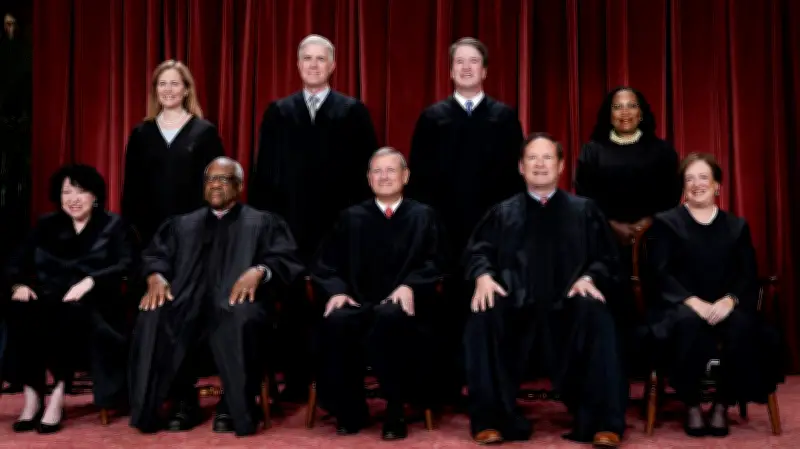
The Supreme Court announced Monday that it will consider enforcing strict Arizona voting laws passed by Republicans after the 2020 election, marking a major test of state voting restrictions in a key swing state.
Case Background
The high court has previously allowed similar rules to take effect temporarily, including Arizona's proof-of-citizenship requirement for state and local elections and a Virginia voter roll purge aimed at preventing noncitizen voting. President Donald Trump's administration joined the appeal after lower courts found the measures violated federal voting laws. The court is expected to hear arguments in fall 2025 and issue a ruling after the midterm elections.
The Republican-controlled Arizona legislature passed the laws in 2022, part of a wave of proposals nationwide following Trump's false claims of widespread voter fraud in his 2020 loss to Democrat Joe Biden. Trump won Arizona in 2024, helping secure his return to the White House.

Previous Court Actions
The case reached the Supreme Court's emergency docket in 2024, when justices gave Republicans a partial victory by allowing Arizona to require proof of citizenship for state and local registration but not federal races. That same year, the court permitted Virginia to continue its voter roll purge shortly before the election.
Citizenship is required to vote nationwide, and registrants must attest to citizenship under penalty of perjury. Arizona is among a handful of states demanding additional proof, such as a driver's license or passport. Data indicates noncitizen voting is rare.
Federal vs. State Elections
Arizona attempted to impose proof requirements for national elections in 2013, but the Supreme Court struck down that law. Currently, individuals can register as "federal only" voters without citizenship proof, but Arizona requires additional documentation for state and local participation.