On April 17, the Charter of Rights and Freedoms turned forty-four. The same morning, Minister of Justice Sean Fraser toured the Library and Archives Preservation Centre in Gatineau, Quebec, and told reporters he is considering guardrails around how Section 33 is used at the federal level. Section 33, the notwithstanding clause, allows Parliament or a provincial legislature to pass a law that operates notwithstanding certain Charter rights, for a renewable five-year term.
Martha Jackman, a professor emeritus at the University of Ottawa specializing in constitutional law, supplied the accompanying assessment: “Every time Section 33 is invoked, that is a nail in the coffin of the Charter.” That view is drifting from the legal academy into the federal conversation, and from there into litigation now before the Supreme Court. It deserves to be taken seriously. It also rests on a misreading of how the Charter came to exist. The evidence sits a short walk from where Fraser stood.
The 1981 Compromise
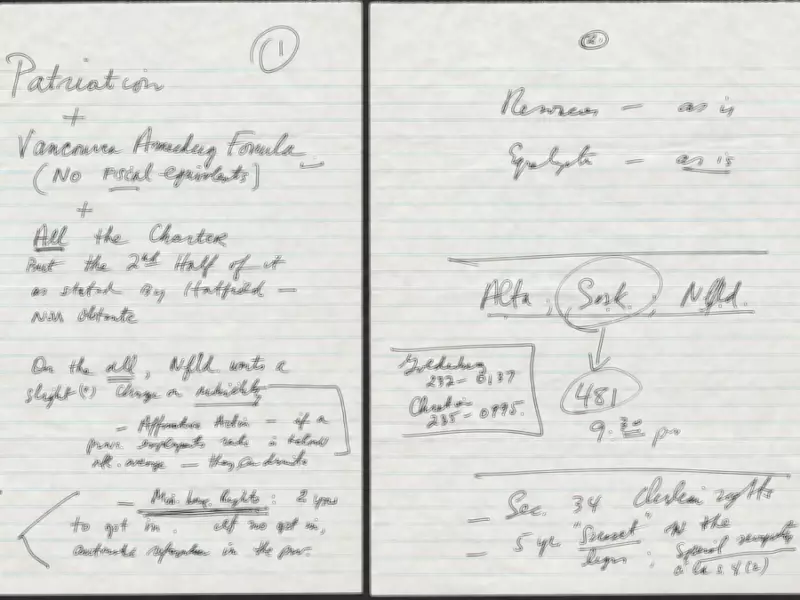
On Nov. 4, 1981, three men met in a kitchen pantry off the main hall of the government conference centre in Ottawa. Jean Chrétien, the federal justice minister, sat across from Roy Romanow of Saskatchewan and Roy McMurtry of Ontario. The constitutional talks had collapsed. Pierre Trudeau was preparing to go it alone. The provinces were fractured. Canada’s constitutional moment was slipping away.

What happened next is the most consequential act of constitution-making in modern Canadian history. On a lined notepad, Romanow scrawled the terms of a compromise in shorthand. The note, now housed at Library and Archives Canada, reads: “All the Charter But the 2nd Half of it… Non Obstante.” On the second page: “5 yr ‘Sunset.’” That was Section 33, the so-called notwithstanding clause. And without it, there would have been no Charter of Rights and Freedoms.
The Bargain Under Pressure
That bargain is now under pressure from several directions at once. So runs the testimony of the people who made the Charter. Chrétien himself, introducing the final amendments to the House of Commons on Nov. 20, 1981, defended Section 33 not as a necessary evil, but as a principled feature of the constitutional design. It would serve, he told Parliament, as a “safety valve” to ensure that legislatures, and not just courts, would have a meaningful role in defining the content and boundaries of rights. Peter Lougheed, the Progressive Conservative Premier of Alberta who first proposed the override mechanism, stated the bargain plainly: Trudeau got his Charter of Rights, and the provinces got both the amending formula and the notwithstanding clause. That was the deal.
Manitoba has introduced legislation that would automatically refer any provincial bill invoking Section 33 to its court of appeal for an advisory opinion. At the federal level, the justice minister has signalled that similar measures are under active investigation. These developments, combined with a case before the Supreme Court involving the English Montreal School Board, threaten to rewrite the constitutional compromise that gave Canada its Charter.
The 1981 Kitchen Accord was a delicate balance. Courts must not undermine it by reinterpreting Section 33 in ways that betray the original agreement. The notwithstanding clause was the price of the Charter, and it remains a vital tool for democratic dialogue between legislatures and the judiciary.