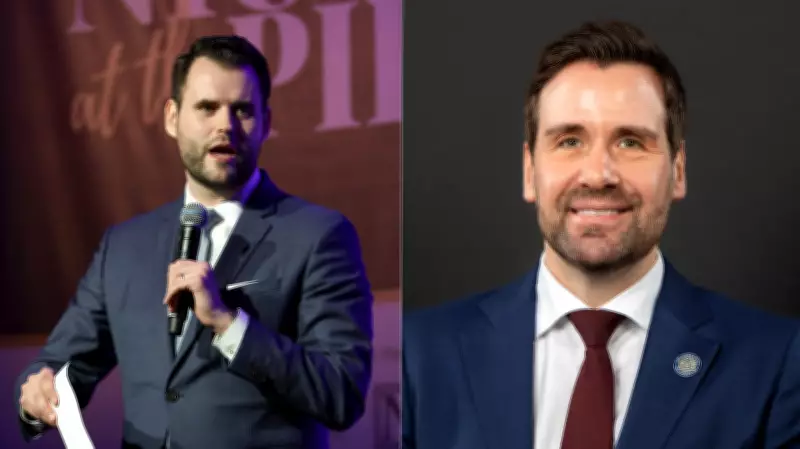
State Sen. Zach Wahls and State Rep. Josh Turek are locked in a battle to challenge GOP Rep. Ashley Hinson for Iowa's Senate seat in November. The primary has unexpectedly emerged as the nation's clearest test of the Democratic rank-and-file's anger at party leadership, with Wahls hoping that biting critiques of Senate Minority Leader Chuck Schumer can counteract big money backing his opponent.
Wahls vs. Turek: A Proxy War for the Party's Soul
Wahls, long seen as the frontrunner, is trying to battle back against $5 million spent by VoteVets, a super PAC that typically backs Democratic veterans, in support of Turek. The race is taking place amid a wave of optimism among Iowa Democrats who believe the state's working-class voters are fed up with sluggish growth. The outcome could determine whether the party can turn the reliably red state into a battleground and create another pathway to win back control of the Senate.
"I do not think we are going to win in November if we cannot be honest about the need for new leadership for our party in Washington, D.C.," Wahls said in an interview. "And that starts with Senator Schumer." Wahls has said repeatedly he believes the party should move on from Schumer's leadership, while Turek has been publicly neutral on the issue. Schumer has not officially endorsed Turek, but D.C. leaders' preference for him is a poorly kept secret. Turek, they believe, is the better choice to win in November because of his inspiring personal story — he was born with spina bifida and won two gold medals in wheelchair basketball as a Paralympian — and his history of victories in territories President Donald Trump won.

National Implications
Other progressive Senate candidates nationally, including Illinois Lt. Gov. Juliana Stratton and Michigan State Sen. Mallory McMorrow, have said they would not back Schumer as leader, but none have made it as central to their campaigns as Wahls has. His strategy is set to be closely watched nationally as Democrats question the leader's decision-making following Schumer-backed Maine Gov. Janet Mills' decision to drop out of the Democratic primary there. Mills' decision has already encouraged other candidates who oppose Schumer to re-emphasize their positions.
"I'm the only candidate in this race who hasn't danced around this. I said we need new leadership in the U.S. Senate, and I mean it," McMorrow wrote on social media on Thursday.
But in the same way progressive oysterman Graham Platner's victory over Mills was built on a financial advantage, VoteVets' advertising blitz is giving Turek a significant leg up. The group released a poll Tuesday showing Turek surging to a 48% to 28% lead over Wahls after trailing him by a nine-point margin in March. A significant 24% chunk of primary voters remained undecided.
Wahls' allies believe VoteVets' heavy spending in the race is at Schumer's behest and plan to make it a major issue in the final weeks of the race, arguing any candidate who is the pick of D.C. insiders does not have a chance to win at a time when Congress and Democratic leadership are as unpopular as ever. (VoteVets, which won't have to reveal its donors until after the June 2 primary, says they are supporting Turek because his disability is linked to his father's exposure to Agent Orange in Vietnam.)
It's an argument that could prove potent, said Jeff Link, a veteran Iowa Democratic strategist who is neutral in the primary. "You can't run as the choice of the Washington insiders and be successful statewide in Iowa," Link told HuffPost, citing the state's history of backing political outsiders in both parties.
The GOP is reveling in the primary. "Iowa is the first battle in the Chuck Schumer-Elizabeth Warren proxy war, and with Zach Wahls leading in the polls, it will be up to Schumer to save his stooge Josh Turek," said NRSC regional press secretary Samantha Cantrell, referring to the progressive Massachusetts senator who has endorsed Wahls.

But they also realize they need to take the outcome of the proxy war seriously, even if they remain outwardly confident about their chances. Senate Leadership Fund, a super PAC controlled by allies of Senate Majority Leader John Thune, has reserved $29 million worth of television airtime in the state for the fall to back Rep. Ashley Hinson, who the party quickly rallied behind following incumbent Sen. Joni Ernst's decision not to run for reelection.
Wahls' Strategy: Anti-Schumer Populism
In an interview, Wahls repeatedly brought up a now-infamous Schumer assertion that Democrats would win enough college-educated voters to make up for any working-class support they lost to Trump — a prediction that would prove disastrous in states like Iowa. "The voters we need to win are in those communities that have been written off by people like Chuck Schumer for way too long," Wahls said, pointing to his work to help protect trailer park residents from predatory investment firms.
Turek downplayed his ties to Schumer in an interview, saying he met with the New Yorker once before announcing his run, but that it was his own decision to enter the race after Ernst voted for a GOP budget that included cuts to Medicaid. "I was never recruited," he said.
For his part, Turek simply argues that Wahls' track record — he was once the leader of the Democrats in the Iowa Senate and backed Warren for president in 2020 — makes him unelectable in a red state. "I think Zach is a smart and articulate guy," he said. "I don't think he can win statewide."
Republicans, at times, have seemed to agree — the NRSC released a poll showing Wahls in the lead in February, which many took to suggest he's their preferred opponent in November. But the limited public polling of the race has shown little difference between how Wahls and Turek perform against Hinson.
Similarities and Differences
While Turek is the more moderate candidate, the two men have spent relatively little time arguing about ideology. Indeed, much of their pitch to Iowa voters sounds shockingly similar. Turek calls himself a "prairie populist," while Wahls pledges to put "Iowans over insiders." Both argue the wealthy have too much influence on politics, talk about breaking up monopolies and think a focus on "unrigging the economy" and "kitchen table issues" can convince Iowans to back a Democrat.
Even Turek, who has faced intra-party criticism for past votes on abortion rights and immigration, brushed aside the idea that the party may need to move to the center on social and cultural issues. "So many politicians don't have the discipline to stick to the messaging," Turek said. "It's about focusing on the issues that matter to 3.2 million Iowans, like affordable housing, affordable healthcare, water quality and public schools."
Turek also argued that his personal story, including his working-class background and struggles with his disability, gives him a unique pitch for voters, citing how he sells his support for a public option for health insurance. "Especially having the credibility of a physical disability and coming through the circumstances, I've gone through, with 21 surgeries [by the age of 12], that resonates with people not as a woke, progressive idea, but as a common sense idea," he said.
Geography and Electability
Much of Turek's electability pitch is based on simple geography. Wahls represents the university town of Iowa City, with his district ranking among the state's bluest. Turek represents Council Bluffs, a town on the Iowa-Nebraska border which voted for Trump in 2020 and 2024, and represents the most Republican seat in Iowa held by a Democrat.
"Somebody who's won a Trump district in a Trump-won county has a far better chance for the general election than somebody who has never even ran against a Republican," said state Rep. J.D. Scholten, who briefly mounted his own bid for Senate before dropping out and endorsing Turek.
But that geography may work against Turek in the primary. Iowa's eastern half, which includes large-for-Iowa cities like Cedar Rapids and Davenport, has far more Democratic voters than the more agricultural communities in the state's west. Link suggested that Wahls' path to victory would not require matching VoteVets' spending dollar-for-dollar if he could use his strong support from organized labor to turn out voters and raise enough money to make voters aware of his platform.
"If he can get $1.5 million on TV, that'll get him to the point where the over-50 crowd knows who he is," Link said, referring to older voters who tend to cast the most ballots in primaries.