Carney's Davos Address: A Bold Declaration or Calculated Rhetoric?
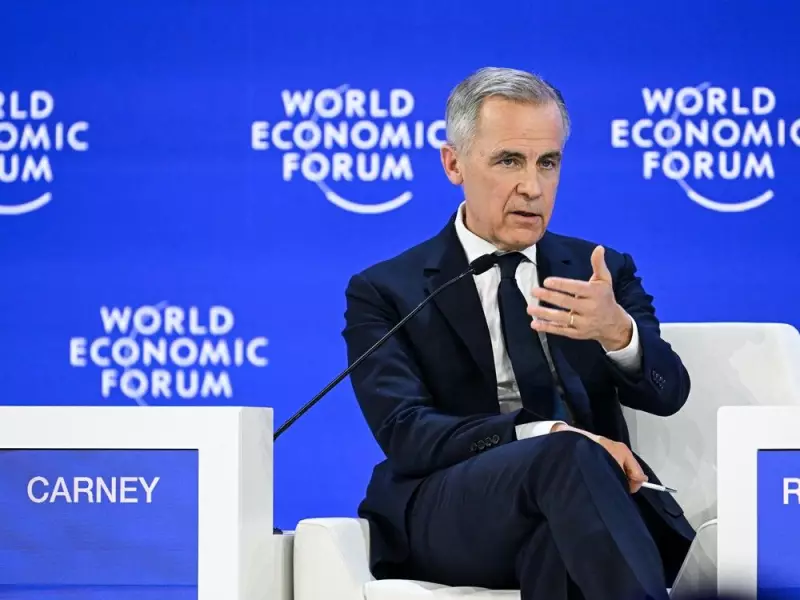
In a historic moment at the World Economic Forum in Davos, Canadian Prime Minister Mark Carney delivered a speech that resonated with both urgency and controversy. Speaking before an assembly of global financiers, political leaders, and influential figures, Carney issued a stark challenge to the established international order, accusing the Davos elite of "living within a lie."
The Core Message: Confronting Fiction with Reality
Drawing inspiration from the dissident writings of Vaclav Havel during 1970s Czechoslovakia, Carney framed the international rules-based system as a collective delusion. He argued that this framework has become as disconnected from reality as the communist ideologies Havel criticized decades ago. The Prime Minister's central plea was for middle powers, caught in the escalating rivalry between the United States and China, to "live the truth" by naming reality clearly, acting consistently, and building institutions that reflect genuine beliefs rather than convenient fictions.
While Carney did not explicitly call for "middle powers of the world unite," this sentiment was unmistakably the underlying takeaway from his address. He implored nations watching with apprehension as a "Trumpified" America confronts authoritarian China to move beyond passive observation and toward principled action.

Questioning Carney's Credibility and Consistency
However, the power of Carney's message is immediately tempered by scrutiny of his own political trajectory. The Prime Minister possesses a documented history of advocating for certain values until circumstances shift, raising legitimate questions about whether his Davos pronouncements represent sincere conviction or strategic triangulation.
Consider the ambitious environmental and ethical promises outlined in his 2021 book, 'Values.' Many of those commitments have since faded, appearing "deader than a door nail," alongside the concept of a "values-based foreign policy" he once championed. This pattern invites skepticism, particularly because Carney himself has long been emblematic of the "Davos Man" archetype he now critiques—a global insider deeply embedded in the very systems he questions.
This contradiction does not inherently invalidate his current arguments, but it places a significant burden of proof upon him. As noted in political circles, a genuine conversion requires demonstrable action, not merely eloquent speech. It is a "show," not a "tell."
Domestic Context and the Shadow of the Trudeau Era
The critique extends to the domestic Canadian landscape. As Conservative MP Michelle Rempel Garner highlighted in her response to the speech, Carney's Liberal Party could be accused of perpetuating a comparable "lie" to the Canadian public during much of the preceding Trudeau government.
That period was characterized by soaring household costs, rapidly increasing immigration levels, and a decline in housing construction and public service provision, all while official narratives often suggested stability and progress. Although Carney was not a member of that government, he did not publicly challenge its policies or narratives at the time, instead remaining a supportive, if external, figure often rumored to be joining the political team.
A Changed World Demanding a New Approach
The geopolitical landscape has undeniably transformed since the Trudeau years. The return of Donald Trump to the U.S. presidency has introduced unprecedented volatility, with the administration adopting tactics that critics describe as resembling a "mafia state"—targeting political opponents through legal channels, assaulting a free press, and demanding tribute from allies and businesses alike.
No previous Canadian leader has faced a scenario where a U.S. president declares war on a NATO ally over a personal grievance like a denied Nobel Peace Prize. In this context of global instability, Carney is positioning himself and Canada as advocates for a rational, principled course correction, applying his considerable intellectual heft to navigating these turbulent waters.

Ultimately, Carney's Davos speech stands as a powerful rhetorical challenge to global complacency. Its lasting impact, however, will depend entirely on whether his words translate into consistent, credible action that overcomes the skepticism born of his own political history. The world is watching to see if this call for truth is itself a lasting truth.