

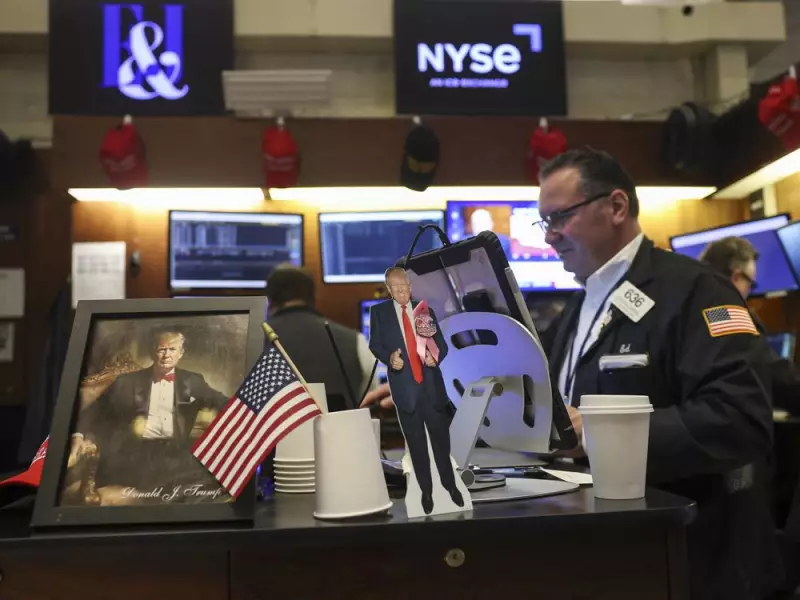
Wall Street Strategists Identify Buying Opportunities Amid Political Turmoil and Market Volatility
Financial markets have experienced significant turbulence in recent days, with geopolitical tensions and political uncertainty creating a challenging environment for investors. Despite these headwinds, prominent Wall Street strategists are pointing to underlying strengths that could present buying opportunities for those willing to navigate the current chaos.
Geopolitical Tensions Create Market Uncertainty
The United States has escalated its efforts to gain control of Greenland, threatening economic measures against several European nations despite existing trade agreements. This development comes alongside political uncertainty in Japan that has roiled global bond markets, creating a ripple effect across developed markets worldwide. Additionally, concerns persist about the Federal Reserve's independence under the current administration, adding another layer of complexity to the investment landscape.
These factors contributed to a significant market downturn on Tuesday, with the S&P 500 experiencing its worst single-day decline since October, erasing all gains for 2026 before recovering somewhat on Wednesday. The CBOE Volatility Index spiked above 20, reaching its highest level since the artificial intelligence sector correction in November.

Historical Patterns Suggest Resilience
Despite the apparent reasons for market concern, historical analysis provides a more optimistic perspective. According to Alastair Pinder, head emerging markets and equity strategist for HSBC Holdings PLC, U.S. stocks have actually risen following 60 percent of major geopolitical events since 1940. In a recent research note, Pinder emphasized that markets have consistently looked past geopolitical unrest, with the primary exception occurring when such events drive oil prices sharply higher.
"Many investors worry it could rattle equity markets. We are less convinced," Pinder wrote, noting that current oil prices for both Brent and West Texas Intermediate remain well below long-run averages, reducing the likelihood of sustained market disruption from geopolitical factors alone.
Strong Fundamentals Support Bullish Outlook
Beyond historical patterns, several fundamental factors support a positive market outlook. Corporate profits are projected to grow by approximately nine percent in the fourth quarter, with double-digit percentage growth anticipated throughout 2026. The artificial intelligence sector continues to deliver substantial returns for major index components, while investor interest is broadening to include companies across healthcare, resources, and consumer goods sectors.
Technical indicators further reinforce this optimistic assessment. Last week concluded with roughly 70 percent of S&P 500 index stocks trading above their 200-day moving averages. Both the Russell 2000 index and the equal-weighted version of the S&P 500 reached fresh record highs, suggesting broad-based market strength rather than concentration in a few large companies.
Strategic Perspective on Current Conditions
Chris Verrone, head of technical and macro strategy at Strategas Asset Management LLC, acknowledges that market sentiment has become one-sided and ripe for correction. However, he emphasizes the importance of maintaining perspective on longer-term trends. "Nothing prevents a consolidation here, particularly with sentiment so one-sided and ripe for a check, but we still defer to the longer-term trend for perspective," Verrone noted.
The current market environment presents a complex picture for investors. While geopolitical tensions and political uncertainty create legitimate reasons for caution, underlying market fundamentals and historical patterns suggest resilience. Wall Street strategists point to strong corporate earnings projections, broadening market participation, and historical precedent as reasons to maintain a constructive outlook despite short-term volatility.
As markets continue to navigate these turbulent conditions, investors face the challenge of balancing legitimate concerns about geopolitical risk with the potential opportunities presented by solid economic fundamentals and historical market resilience patterns.






