

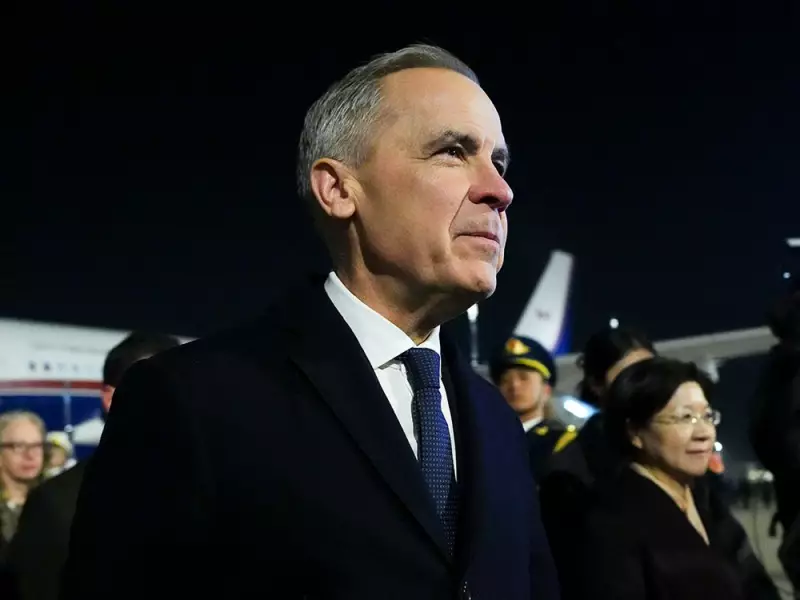
Prime Minister Mark Carney has arrived in Beijing, facing the delicate diplomatic challenge of engaging with a global superpower that Canada both distrusts and cannot afford to ignore. His visit, which began on Wednesday, January 14, 2026, is widely seen as an effort to lower the temperature in a strained bilateral relationship and explore pragmatic trade solutions.
Navigating Between Protectionism and Antagonism
Canada finds itself in a precarious position, caught between a sharply protectionist Trump administration in the United States and a Chinese regime whose actions frequently run counter to Canadian interests. The urgency for new trade avenues is underscored by shifting export patterns. In October of the previous year, Canadian exports to the U.S. accounted for just 67.3% of the total, marking the lowest non-pandemic level since current data tracking began in 1997. This is a stark contrast to 2001, when 87% of Canada's exports went south of the border.
While the United States will remain a crucial partner, the declining share highlights a pressing need for market diversification. Efforts with nations like Vietnam and Indonesia are helpful, but their scale is limited; Canada's annual exports to Jakarta equal what it sends to China in a single month. Bridging the U.S. shortfall will necessitate significantly expanded trade with either Europe or China.

The Challenge of China's State-Driven Trade
The core difficulty for Canada lies in Beijing's approach to commerce, which it wields as an instrument of state power. Chinese industries, such as automotive, benefit from massive state support—subsidies totaling US$230 billion in the auto sector alone—which can swamp global markets without equivalent foreign industrial policies. This strategy has proven effective, with Chinese automakers now holding 20% of all car sales in Latin America and a dominant 75% share of the battery electric vehicle segment there.
In a November essay for The Economist, Prime Minister Carney framed this new reality as an era of "variable geometry," a term describing the formation of pragmatic, interest-based coalitions between countries not traditionally considered allies. He predicted the emergence of a "mosaic of partial agreements" rather than sweeping deals built on shared institutions.
Prospects for a Modest Breakthrough
This concept of a partial agreement is precisely what observers expect from the current Beijing trip. Chris White, president of the Canadian Meat Advocacy Office and Canada Pork, who is based in Beijing, indicated both sides are motivated to de-escalate tensions. He stated there is an expectation of "modest movement" on two key tariffs: Canada's 100% tariff on Chinese electric vehicle imports and China's punishing 76% tariff on Canadian canola.
The form of the Canadian concession on EVs remains to be seen; it could involve a suspension of the tariff pending further study or a direct percentage reduction. However, a complete removal of the EV tariff is considered unlikely. The visit is primarily intended to signal a normalization of relations, paving the way for ministers and bureaucrats to follow up.
Carney's diplomatic maneuvering is not without domestic risk. He is already facing warnings from allies of former President Donald Trump that the Beijing visit "won't end well" for him if he is perceived as growing too close to Chinese leader Xi Jinping. The Prime Minister's task is to secure tangible economic benefits for Canada while navigating these complex geopolitical crosscurrents.






