

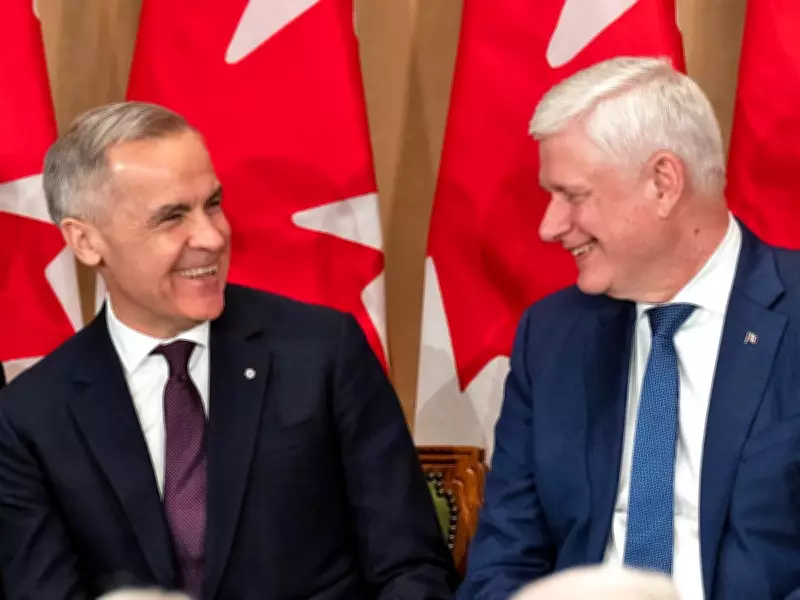
Canadian Political Unity Emerges Amid Global Turmoil as Harper Portrait Unveiled
The recent unveiling of former Prime Minister Stephen Harper's official parliamentary portrait has created an unexpected moment of political catharsis in Canada, highlighting a rare consensus that stands in stark contrast to the fragmentation seen in other Western democracies.
An Unprecedented Display of Cross-Partisan Respect
Speaking at an event hosted by the Royal Canadian Geographic Society, Harper noted Canada's tendency to focus on past mistakes rather than celebrating national achievements. This observation resonated deeply within a political landscape typically dominated by partisan divisions.
What made the occasion particularly remarkable was the presence and praise from current Liberal Prime Minister Mark Carney, who lauded his Conservative predecessor as a "conviction politician" who brought "composure, intellect and decisiveness to public life." Carney further acknowledged Harper's pragmatic leadership during the 2008 financial crisis, emphasizing how his government took necessary actions to support the Canadian economy through what was then the worst global downturn in generations.

Carney's perspective carries particular weight given his role as Governor of the Bank of Canada during that critical period, placing him directly in the room where many significant economic decisions were made.
Global Context Highlights Canadian Exceptionalism
To fully appreciate the significance of this moment of Canadian political unity, one must examine the broader international landscape where democratic institutions face unprecedented challenges.
In Europe, right-wing populist movements are gaining substantial ground. France and Germany both witness the ascendancy of nationalist parties, with the Alternative for Germany potentially coming to power in Saxony-Anhalt state elections this September—marking the first time a far-right party would govern in Germany since the Nazi era.
In the United States, former President Barack Obama recently issued a statement characterizing the killing of ICE protester Alex Pretti as a "wake-up call to every American" that core national values face increasing assault under the Trump administration. Current President Donald Trump has further complicated the political landscape by suggesting the Republican Party might "nationalize" voting processes, potentially removing authority from states that didn't support him in previous elections.
The Jeffrey Epstein scandal continues to spread internationally, implicating numerous high-profile figures including Trump administration officials and former President Bill Clinton, despite their denials of wrongdoing. In the United Kingdom, the scandal has shaken both political and aristocratic circles, with former Labour minister Peter Mandelson accused of passing market-sensitive information to Epstein and Andrew Mountbatten-Windsor facing multiple sordid allegations.
A Renewed Sense of Canadian Pride
Harper's return to Ottawa—twenty years after forming his first government—has unexpectedly highlighted what appears to be a growing sense of national cohesion. The Canadian political class, spanning from Harper to Carney, seems energized by a surge in Canadian pride observed over the past year.
This emerging consensus represents more than mere political theater. It suggests a maturing of Canadian democracy where respect for institutional processes and acknowledgment of substantive contributions can transcend partisan boundaries. While other nations grapple with polarization, scandal, and institutional erosion, Canada demonstrates that democratic traditions can foster moments of genuine unity even among ideological opponents.
The portrait unveiling ceremony thus becomes symbolic of broader trends in Canadian society—a willingness to recognize leadership qualities across party lines and an appreciation for stability in increasingly unstable times.






