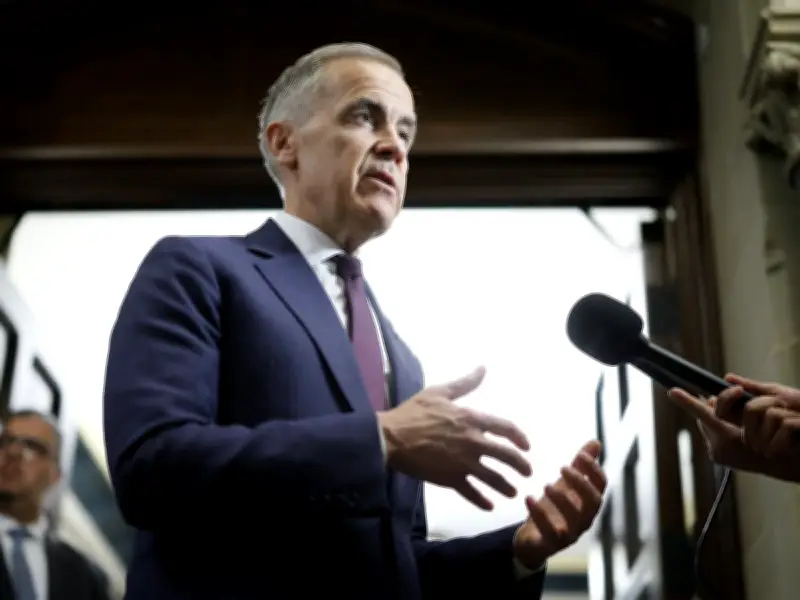
Prime Minister Mark Carney stated that the Trump administration's latest tariff threat, stemming from an investigation into forced labour supply chains, is "not a surprise" and that Canada supports the overarching goal of eradicating forced labour practices.
Canada's Response to U.S. Tariff Threat
Speaking on Wednesday, Carney hinted that his government will soon propose more stringent measures to better halt the importation of goods produced with forced labour into Canada. "Canada has a very strong legislative regime against forced labour in supply chains," he said. "We don't want any element of forced labour coming in goods and services, and we want to use our influence to eliminate this practice of forced labour and child labour."
Carney noted that his government has been exploring ways to "reinforce" its regime to more effectively stop imports of forced labour goods. He indicated that the intention is to table these legislative measures in the House of Commons before the session ends on June 19.

U.S. Report and Proposed Tariffs
The United States Trade Representative (USTR) released a report late Tuesday stating that Canada, Mexico, the European Union, and other countries have "failed to effectively enforce a prohibition on the importation of goods produced with forced labour." The USTR is invoking Section 301 of the Trade Act of 1974, which addresses unfair foreign acts, policies, or practices affecting U.S. commerce. As a result, the Trump administration proposes a 10% additional tariff on these countries, including Canada. Dozens of other nations with partial or no bans on forced labour imports could face a higher duty of 12.5%.
"The failure of our most important trading partners to address the importation of goods made with forced labour is unacceptable," said U.S. Trade Representative Ambassador Jamieson Greer in a statement. "This creates a dynamic where American workers are forced to compete globally on an unlevel playing field."
Diplomatic Engagement
Dominic LeBlanc, the minister responsible for Canada-U.S. Trade, met with Greer in Washington D.C. on Tuesday to convey Canada's position on the issue. "I would say that the conversation today helped the Americans understand our shared commitment to issues like… the question around forced labour and the fight against forced labour," LeBlanc told reporters before the meeting. "It won't surprise you that we share the concern of the Americans and other economic partners that we need to do everything we can together to face this challenge." LeBlanc declined to speculate on whether Canada would retaliate if the new tariffs are implemented, stating, "We're not going to answer hypothetical questions about a potential response to a measure that we haven't seen."