Photographer Blair Gable was granted rare access to document the often-invisible workers who keep Canada's House of Commons running smoothly—from parliamentary pages and library conservators to upholsterers and wood carvers. These specialized professionals work behind the scenes to preserve the institution's function and heritage.
Parliamentary Pages: The Vigilant Shadows of the Chamber
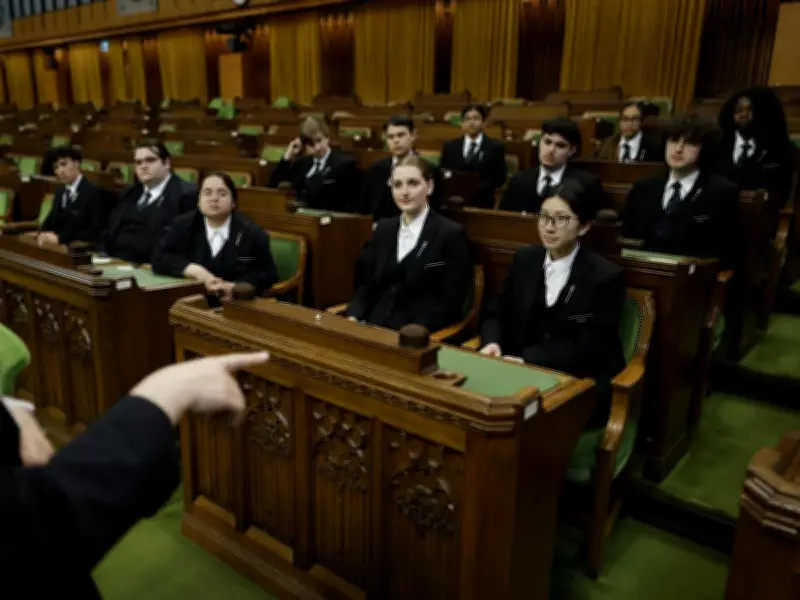
Parliamentary pages are university students who serve as the chamber's silent assistants. They unlock MPs' desks before sessions, deliver speeches for the record, and provide water (still or sparkling, with lemon or lime per MP preference) during proceedings. No other beverages are permitted while the House sits. Their uniform—black jacket and pants with a white shirt—reflects their role as nearly invisible support.
Becoming a page is rigorous: applicants undergo written submissions, interviews, and reference checks, followed by weeks of training that culminate in a written exam requiring identification of all 343 Members of Parliament. Few political journalists could pass this test, according to reporter Matteo Cimellaro.

Library of Parliament: Preserving Democracy's Record
The Library of Parliament's conservation team works in a Gatineau workshop bathed in natural light. Assistant conservator Maria Salgado uses a custom tool—a spoon with a flattened bowl, a gift from a retired colleague—to carefully remove tape from book covers before rebinding. Senior binder Emily Loker demonstrates marbling techniques, using a dropper to add paint to seaweed-based water, then waving it with a nail tool to create kaleidoscopic patterns for special books.
Preservation librarian Shannon Mooney showed two rare volumes: John James Audubon's The Birds of America, with life-size illustrations, and a scrapbook compiled by one of Parliament's first librarians containing newspaper reports of speeches from the early House—the only surviving record before official records began in 1875.
Trades Services: Craftsmanship Behind the Green Chamber
In an Ottawa warehouse, upholsterers restore the iconic green chamber chairs. A cross-section reveals six springs under layers of burlap, foam, felt, and a tangle of horse and hog hair—traditional padding that doesn't break down like synthetic fibres. "Quite a mishmash," said Chelsea Koski, supervisor of the upholstery and framing shop. The hair is "incredibly expensive" and increasingly hard to source, so workers reuse it by fluffing and restuffing.
Manager of trades services Sylvain Beaulne emphasized the cost savings of in-house work: "Moneywise, you're saving so much to Canadians, it's crazy." Refurbishing rather than replacing allows furniture to last indefinitely. Wood worker Jean-Sébastien Hotte is the only person trusted with the intricate hand-carved woodwork that adorns many House surfaces. As MPs consider replacing chairs with benches to accommodate more members, Beaulne said his team is ready: "We're hoping by next year, we'll get a final design for us to start building whatever they ask us to build."