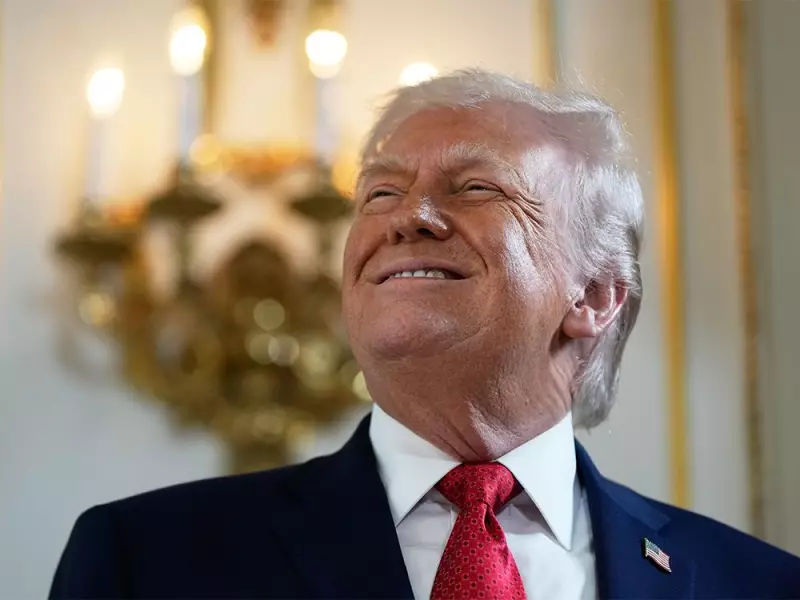
As President Donald Trump commemorates the first anniversary of his second inauguration this Tuesday, a defining theme has emerged for his administration: a pronounced shift toward expansive federal authority. This direction stands in stark contrast to the conservative principles he and his supporters often claim to champion.
The Ghost of Clinton's Declaration
The current political landscape invites a comparison to a pivotal moment three decades ago. In 1996, then-President Bill Clinton, a Democrat who had positioned himself as a centrist "new Democrat," used a State of the Union address to famously proclaim "the era of big government is over." This declaration was meant to signal a break from the liberal traditions of Franklin D. Roosevelt and Lyndon B. Johnson.
Fast forward to 2026, and the unifying theme of Trump's second term could be summarized as its direct opposite: The Era of Big Government is Back. This analysis argues that Trump's approach is, in several respects, less conservative than the stance Clinton took thirty years prior.

Expansive Control and the Tariff Hammer
The Trump administration's version of big government manifests in several key areas. Federal spending remains high, with significant deficits projected far into the future, while support for social programs aiding low-income Americans, such as food stamps and health insurance subsidies, has faced cuts. There is also a marked trend toward federal micro-management of the economy.
The president has shown a desire for direct involvement in a wide array of industries, from semiconductors and steel to automobiles, media, professional golf, and oil. This extends to macro-management as well, with efforts to influence the central bank's control over interest rates and the money supply—a concept that would alarm traditional conservatives.
However, the most frequently deployed tool has been the tariff. Trump's preferred solution to a vast range of problems is to impose new taxes on Americans through import duties. This regressive tax increases the cost of living for consumers, with a disproportionate impact on those with lower incomes.
A Pattern of Punitive Taxes
The article outlines a pattern of using tariffs as a punitive measure for various disputes. When Europeans objected to his interest in Greenland, Trump threatened tariffs on European goods bought by Americans. After Ontario aired a television commercial featuring Ronald Reagan, he threatened taxes on Canadian imports.
The approach was similarly applied when Brazil prosecuted its former president for election interference, leading to proposed taxes on Brazilian coffee. The philosophy extends to domestic choices, with threats of taxes on Americans who buy foreign cars, appliances, or even certain fruits, and on those involved with lethal drugs.
This strategy has led critics to observe that for a leader who favors this one tool, every problem appears to be a nail. The result is a governance model centered on increasing federal revenue and control through taxes that ultimately burden the American public, particularly those struggling financially.
As the first year of Trump's second term concludes, the analysis posits that the administration's actions have fostered a revival of big government, challenging its own narrative of conservative ideology and marking a significant departure from the small-government rhetoric that once defined a wing of the Republican party.