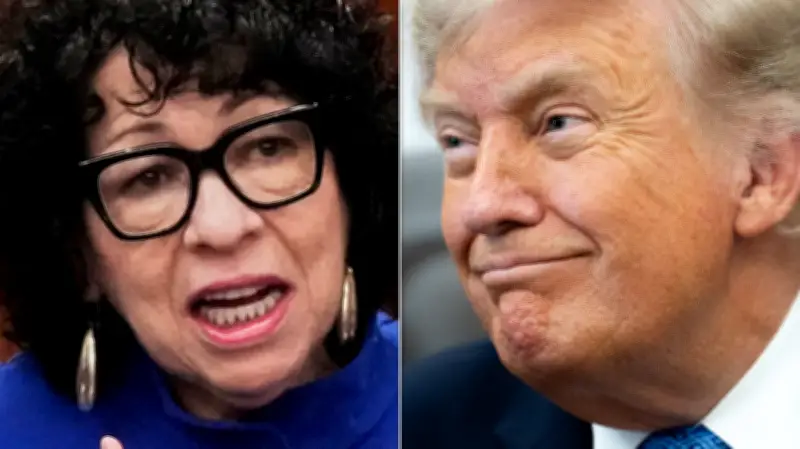
Justice Sonia Sotomayor delivered a blistering dissent on Monday, accusing the Supreme Court's conservative majority of making a 'grievously wrong' decision that hands President Donald Trump more power over the executive branch 'than ever before.' In a 49-page dissent read partly from the bench, Sotomayor expressed profound concern over the ruling that allows the president to fire any member of a regulatory agency for any reason, overturning 90 years of judicial precedent and undermining the separation of powers.
Dissent Joined by Liberal Colleagues
Sotomayor was joined by Justices Elena Kagan and Ketanji Brown Jackson in her dissent. She wrote that the Court 'undoes centuries of political practice and concludes that all three branches of Government have been acting in open defiance of the Constitution all this time.' She emphatically stated, 'Its conclusion is wrong.'
Background of the Case
The case stemmed from Trump's firing of Federal Trade Commission commissioners Rebecca Slaughter and Alvaro Bedoya, both Biden appointees dismissed without stated reason. Chief Justice John Roberts led the six-justice majority in overturning the precedent set by the 1935 case Humphrey's Executor v. United States, which had held that Congress could limit the president's power to fire officials at independent regulatory agencies.

Sotomayor lamented the demise of Humphrey's, now replaced by what she called 'a half-baked theory of executive power' that is both all-encompassing yet limited by undefined exemptions. 'The one thing that does appear to be clear going forward is that chaos will follow,' she wrote.
Concerns for Agency Independence
Sotomayor began her dissent by acknowledging that some government functions should operate 'at a distance from partisan politics.' These include the management of nuclear energy, the security of the monetary supply, and the safety of American workplaces, consumer products, and chemical hazards. She noted that federal agencies overseeing such functions are largely staffed by career officials who serve across multiple presidencies.
'In these and many other areas, the wisdom of the centuries has taught that some decisions should depend not only on who is in office — much less on who is disfavored or owed a favor by those in office — but also on judgment, expertise, and the public good,' she said.
Impact on Agency Function
She wrote that 'it is undeniable' that agencies like the FTC 'will be transformed in ways that those who created them never could have expected and actively sought to avoid, fundamentally recalibrating the balance of power in this country in the process.'
Reversal of Recent Precedent
Sotomayor also argued that the Court reversed a stance it took just six years ago, when the conservative-leaning Court ruled that for certain expert officials, the president could only fire them for 'good cause.' The FTC commissioners would appear to fit that exemption. She spent several pages arguing that the Founding Fathers intended to limit the president's removal power, criticizing the majority's 'radical theory of unitary executive power.'
In her view, federal power is more balanced by allowing expert officials independence and holding them accountable through the political branches. 'Today, the Court discards that democratic regime in favor of one that distorts the structure of Government to fit the majority's theory of unitary, total executive control,' Sotomayor wrote.
'The result is a President who emerges with far greater power than ever before. It is a power, however, that neither the People, nor Congress, nor the Constitution bestowed upon him. In granting the President this unbridled authority, the Court upends its precedent, misconstrues our history, and sheds any pretense of judicial modesty,' she concluded. 'I respectfully dissent.'