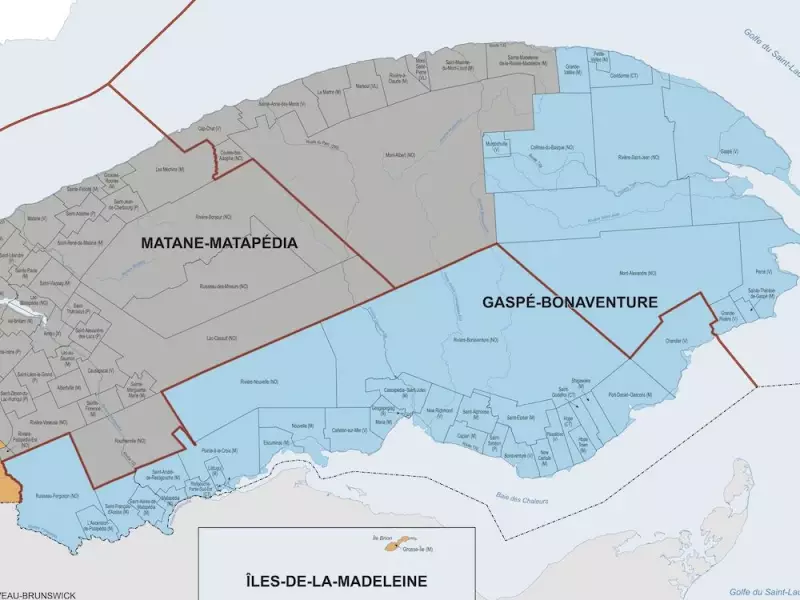
Quebec's independent electoral boundaries commission is forging ahead with a major redrawing of the province's electoral map, a move that will eliminate two ridings and create two new ones in time for the next general election scheduled for October. This decision comes despite unanimous opposition from the National Assembly and a pending government appeal to the Supreme Court of Canada.
Commission Stands Firm on Controversial Changes
On Wednesday, January 15, 2026, the Commission de la représentation électorale announced it is presenting "essentially" the same electoral map it first proposed on December 2. This follows a Quebec Court of Appeal ruling that found a government bill attempting to delay the redistribution until after the next election was unconstitutional.
The finalized map proposes significant changes to reflect shifting population demographics across the province. The riding of Gaspé, whose population has fallen to more than 40 percent below the provincial average, would be merged with the neighbouring Bonaventure riding along Chaleur Bay. On the island of Montreal, the ridings of Anjou and Lafontaine would be consolidated into one.

To balance these removals, the commission's plan calls for the creation of two new ridings in regions experiencing population growth: one in Centre-du-Québec and another in the Laurentians.
Political and Legal Backlash
The plan to eliminate the Gaspé riding has sparked intense political backlash. All four parties represented in the National Assembly objected, arguing that reducing the region to just two MNAs would significantly dilute its political power in Quebec City. In response, the legislature passed a bill on May 2, 2024, designed to halt the redrawing process until after the October election.
However, that bill was successfully challenged in court by the Conseil des préfets et des élus de la région des Laurentides (CPERL), which argued the Laurentians region was chronically under-represented. While the Quebec Superior Court initially sided with the government, the Court of Appeal overturned that decision, paving the way for the commission to proceed.
The Quebec government has since sought leave to appeal that ruling to the Supreme Court of Canada, which has yet to decide if it will hear the case. The newly drawn map must still receive final approval from the legislature, setting the stage for a potential constitutional clash.
Final Adjustments and Democratic Principles
The commission's final report marks the culmination of a two-year process involving a preliminary report, public hearings, and a second revised report. The final version contains only minor adjustments. The boundaries for the new Gaspé-Bonaventure riding remain unchanged, while the merged Anjou-LaFontaine riding in Montreal has been slightly extended to Rivière-des-Prairies Blvd. to preserve a natural community.
The commission also reversed a planned name change for the Matane-Matapédia riding to Matane-Matapédia-Mitis. Under the new boundaries, five municipalities from the MRC La Mitis would move into the Rimouski riding, making the proposed name inaccurate.
In a statement, Chief Electoral Officer Jean-François Blanchet defended the new map. "This new electoral map ensures fairer and more equitable representation of all voters," he said, emphasizing that it accounts for population movement. "It is democratic that a voter's vote, from one riding to another, should have roughly the same influence on the election results."
The commission maintains that while removing a riding always generates strong reactions, the changes are necessary to uphold the principle of electoral parity, ensuring each citizen's vote carries similar weight regardless of where they live in Quebec.