

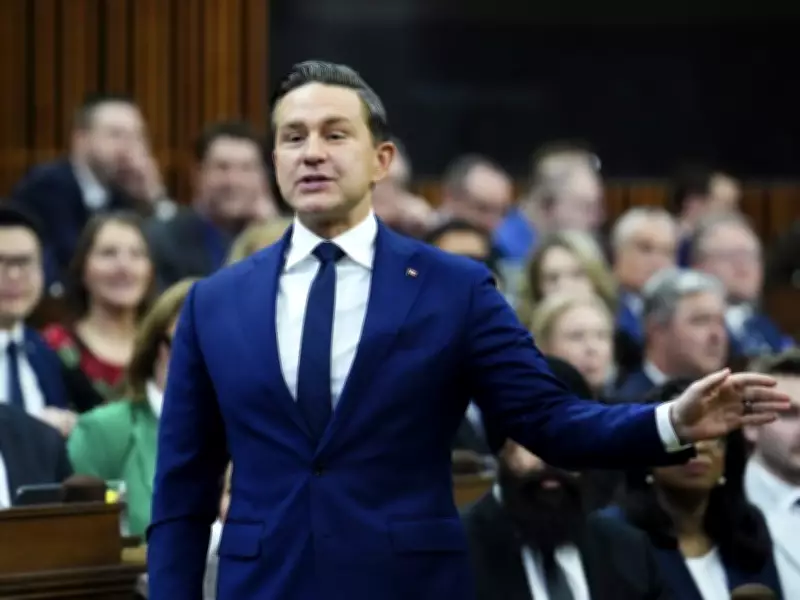
Conservative Leader Proposes Immediate Relief for Drivers Amid Soaring Fuel Costs
Conservative Leader Pierre Poilievre has put forward a bold proposal aimed at providing immediate financial relief to Canadian drivers struggling with skyrocketing fuel prices. In a plan unveiled Thursday morning, Poilievre called for the federal government to suspend both the excise tax and the GST on gasoline and diesel until the end of the year.
Substantial Savings at the Pump
According to Poilievre's calculations, this temporary tax suspension would save drivers approximately 18 cents per litre on every fill-up. The Conservative leader went further by also calling for the cancellation of the Clean Fuel Standard, which he described as "a carbon tax by another name." This additional measure would cut another 8 cents per litre, bringing the total potential savings to 25 cents per litre for Canadian consumers.
"While the Iran war explains the sudden rise in world oil prices, it does not explain why Canadians pay so much more than Americans," Poilievre stated. "Liberal taxes force Canadians to pay 28 cents-a-litre or 20% more than in the United States. High Liberal fuel taxes drive up the cost of groceries, which are already rising the fastest in the G7."

Dramatic Price Increases Documented
The numbers reveal a stark reality for Canadian drivers. At the beginning of the year, the average price for a litre of gas across Canada stood at $1.30. Today, that same litre costs consumers $1.78, representing a 48-cent-per-litre increase in just a few months. The situation is even more severe for diesel, which powers most commercial trucks moving goods across the country. Diesel prices have jumped from $1.66 per litre at the start of the year to $2.31 currently.
Comparisons with the United States highlight the tax disparity. The national average for gas in the United States, when converted to Canadian dollars, works out to $1.47 per litre, while diesel averages $2.00. The significant difference is primarily attributed to higher taxation levels in Canada.
International Precedents and Funding Solutions
Poilievre pointed to international examples where governments have already taken action to ease the burden on citizens. Countries including Spain, Ireland, and Australia have implemented fuel tax reductions to help their populations cope with higher prices resulting from geopolitical tensions.
The Conservative leader argued that the federal government is actually profiting from the current crisis through increased GST revenue generated by higher fuel prices. "On the GST alone, the federal government is bringing in several million dollars per day in windfall revenue they didn't budget for thanks to the higher prices," he noted.
Poilievre suggested that Prime Minister Mark Carney's government could fund these tax cuts by eliminating what he called "wasteful spending." He specifically pointed to the failed gun buyback program, excessive costs associated with outside consultants hired by the federal government, and the controversial $90-billion high-speed rail project that has faced significant opposition along its proposed route.
Human Impact and Political Response
"Canadians deserve affordable fuel and food," Poilievre emphasized. "Seniors should be able to enjoy a worry-free drive to see grandkids, parents should not stress about filling the minivan for hockey practice, and workers should be able to fill their trucks stress-free. That is why Conservatives call for zero tax on gas the rest of the year."
The proposal comes as Alberta has already implemented a program to reduce fuel taxes when prices spike, though its quarterly adjustment mechanism meant relief didn't activate on April 1 despite oil prices exceeding $110 per barrel. The next potential adjustment in Alberta is scheduled for July 1.

Political observers note that Poilievre's plan represents a direct challenge to the Carney government's approach to economic management during a period of significant inflationary pressure. With gas prices reaching what many Canadians consider unsustainable levels, the debate over fuel taxation is likely to intensify in the coming months as households and businesses grapple with the broader economic implications of elevated energy costs.





