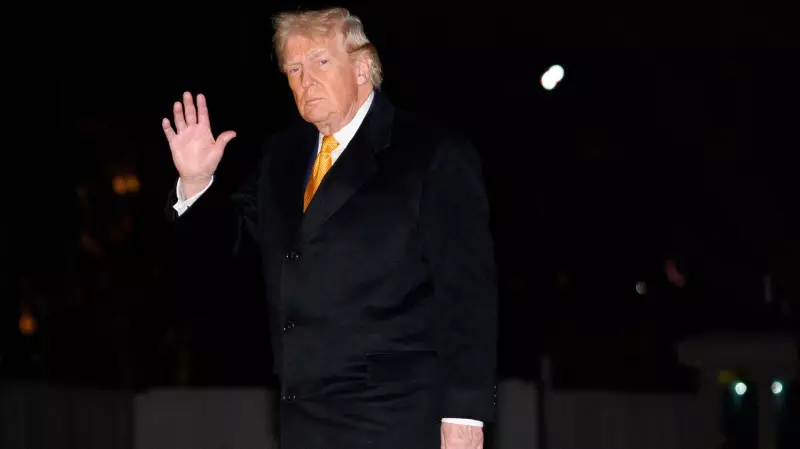
U.S. President Donald Trump has raised the spectre of a second military intervention in Venezuela and suggested potential action against Colombia and Mexico, escalating tensions following the dramatic capture of Venezuelan leader Nicolas Maduro. The comments, made to reporters aboard Air Force One on Sunday, January 4, signal a volatile new chapter in Washington's relations with Latin America.
Threats of Further Military Action and Regional Fallout
President Trump stated that the United States might launch another military strike on Venezuela if remaining members of the administration in Caracas do not cooperate with U.S. efforts to, in his words, get the country "fixed." He explicitly linked the threat to cooperation on clamping down on drug trafficking and overhauling Venezuela's crucial oil industry.
Expanding his warnings beyond Venezuela, Trump suggested that Colombia and Mexico could also face U.S. military action if they fail to reduce the flow of illicit drugs northward. "Operation Colombia sounds good to me," he remarked. Regarding Cuba, a key Venezuelan ally, Trump opined that the island nation "looks like it's ready to fall" without direct U.S. intervention.

Maduro's Capture and Venezuela's Precarious State
The immediate crisis stems from the U.S. operation that captured President Nicolas Maduro, who is now held in a New York detention centre awaiting a court appearance on Monday on drug charges. Images of the 63-year-old Maduro blindfolded and handcuffed have stunned Venezuelans, and the raid represents Washington's most controversial military move in the region since the invasion of Panama 37 years ago.
Venezuelan Defense Minister General Vladimir Padrino stated the attack killed soldiers, civilians, and a "large part" of Maduro's security detail. The Cuban government reported 32 of its citizens were killed during the operation. In response, Venezuela's armed forces have been activated to guarantee sovereignty.
With Maduro detained, Vice President Delcy Rodriguez, who also serves as oil minister, has taken over as interim leader with the blessing of Venezuela's top court. However, the political landscape remains deeply fractured. Top officials like Interior Minister Diosdado Cabello have labelled the detentions of Maduro and his wife a "kidnapping," asserting "there is only one president."
Oil, Migration, and a Contested Path Forward
President Trump framed the mission as a law-enforcement action to bring Maduro to justice on U.S. criminal charges, including narco-terrorism conspiracy. However, he also cited other motivations, stating U.S. oil companies need "total access" to Venezuela's vast reserves. He further claimed Maduro had sent millions of undesirable migrants, including from prisons and mental institutions, to the United States.
These comments have fueled accusations from Caracas that the true U.S. aim is resource extraction. "We are outraged because in the end everything was revealed — it was revealed that they only want our oil," said Cabello.
U.S. Secretary of State Marco Rubio emphasized that Venezuela's next leader must keep its oil industry away from U.S. adversaries and halt drug trafficking, referencing an ongoing U.S. blockade on tankers. Meanwhile, Trump has shown little interest in opposition figure Maria Corina Machado taking power, focusing instead on working with remnants of the current regime.
Domestic and International Reactions
Within Venezuela, the public mood is tense and uncertain. While some Maduro supporters protested in Caracas, opponents have been wary of celebrating, and security forces were less visible than usual. Citizens are stocking up on essentials, navigating a familiar atmosphere of fear.
Internationally, the action has drawn sharp criticism and legal questions. U.S. Senate Democratic leader Chuck Schumer accused the White House of risking an "endless war" and said lawmakers would consider measures to constrain further action. The U.N. Security Council plans to meet Monday to discuss the attack, with major Venezuelan backers Russia and China already condemning the U.S. move.

The capture of a sitting foreign head of state has ignited a fierce debate over international law and sovereignty, leaving Venezuela's future—and the stability of the region—hanging in the balance.