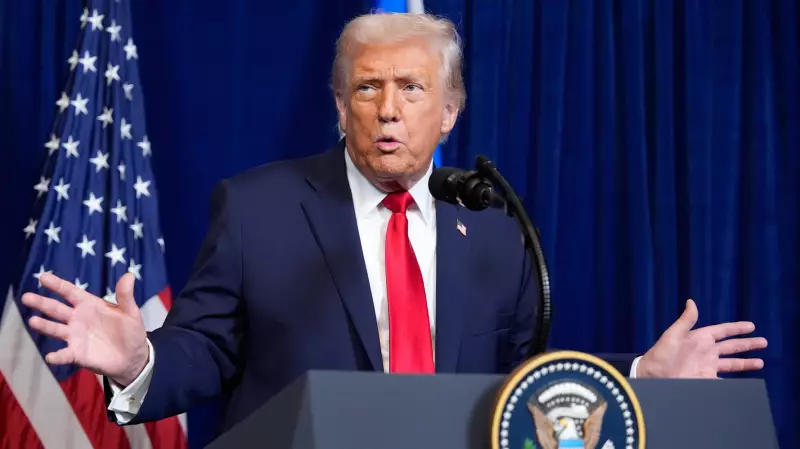
Former U.S. President Donald Trump has issued a direct order to dismantle a multi-million dollar deal involving sensitive computer chip technology, citing an immediate threat to American national security.
Executive Order Targets Semiconductor Acquisition
On Friday, President Trump moved to unravel a transaction valued at $2.9 million. The deal, which initially attracted little public attention, involved the sale of Emcore Corp's computer chips and wafer fabrication operations to HieFo Corp. The purchase price of $2.92 million included the assumption of roughly $1 million in liabilities.
The executive order demands that HieFo divest itself of this acquired technology within a strict 180-day window. The White House action is based on what it describes as "credible evidence" that HieFo's current owner is a citizen of the People's Republic of China, posing an unacceptable risk to U.S. security interests.

Background of the Controversial Deal
The agreement between aerospace and defence specialist Emcore and HieFo was first announced in May 2024 during the administration of President Joe Biden. Emcore was a publicly traded company at the time but was later taken private by the investment firm Charlesbank Capital Partners.
HieFo was founded by Dr. Genzao Zhang and Harry Moore. Notably, Zhang previously served as a vice president of engineering at Emcore before becoming HieFo's Chief Executive Officer. Following the deal's closure, a company press release indicated that the technology's development would continue to be managed by largely the same team of employees based in Alhambra, California.
Zhang had pledged to leverage the acquired technology to "continue the pursuit of the most innovative and disruptive solutions," including applications for artificial intelligence. HieFo has not yet provided a public response to President Trump's divestment order.
Implications for Tech Security and Cross-Border Investment
This forceful intervention highlights the ongoing and intense scrutiny of foreign investment, particularly from China, in critical semiconductor and technology sectors deemed vital to national defence and economic competitiveness. The order effectively reverses a business transaction completed under the previous administration, signalling a stringent approach to safeguarding American technology assets.
The 180-day ultimatum places significant pressure on HieFo Corp to find a suitable buyer approved by U.S. authorities, potentially derailing the company's strategic plans for the advanced chip technology. This case serves as a prominent example of how national security concerns are increasingly dictating the terms of global technology mergers and acquisitions.