NORAD Intercepts Five Russian Military Aircraft Near Alaskan Airspace
The North American Aerospace Defense Command (NORAD) confirmed on Thursday, February 20, 2026, that it intercepted five Russian military aircraft operating in international airspace near Alaska. According to a statement from the joint U.S.-Canada command, the incident occurred on Wednesday, February 19, 2026, and involved Russian Su-35 fighter aircraft and other support planes.
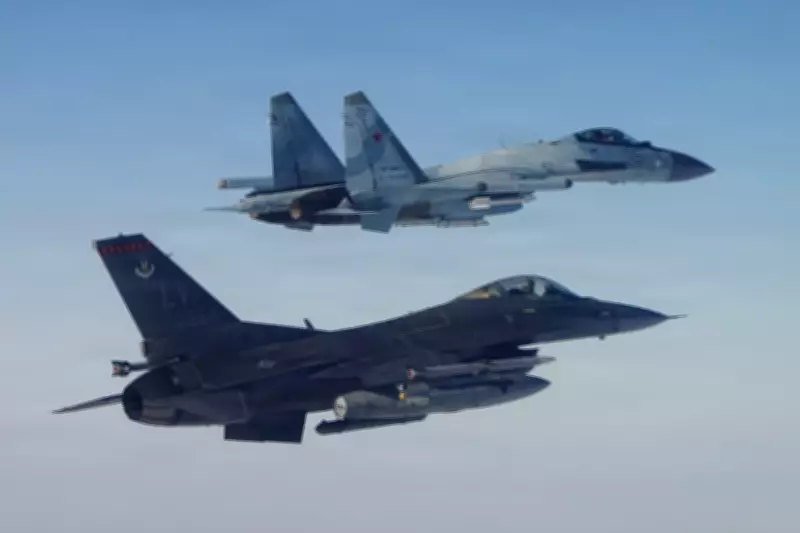
Military officials emphasized that the Russian aircraft remained in international airspace at all times and did not enter American or Canadian sovereign airspace. The NORAD response included the deployment of F-16 fighter jets and other surveillance assets to monitor the situation. A Department of Defense photograph released to media outlets showed an F-16 intercepting a Russian Su-35 near the Bering Strait, west of Alaska.
No Threat to North American Security
In their official statement, NORAD representatives stated clearly that "there was no threat to North American security" from this incident. The command described the intercept as routine and in accordance with standard operating procedures for monitoring and identifying aircraft approaching North American airspace.

"NORAD remains vigilant and ready to respond to potential threats to our homeland," the statement continued. "These intercepts demonstrate our capability to detect, track, and positively identify aircraft of interest in our area of responsibility."
Geopolitical Context and Regional Tensions
The incident occurs against a backdrop of ongoing geopolitical tensions between Russia and Western nations. The Bering Strait region has seen increased military activity in recent years, with both Russian and American forces conducting exercises and patrols in the strategically important Arctic area.
Key aspects of the intercept operation included:
- Five Russian military aircraft detected and monitored
- NORAD F-16 fighters deployed for visual identification
- All aircraft remained in international airspace throughout
- Standard protocol followed for such intercepts
- No communication or safety issues reported
Military analysts note that such intercepts have occurred periodically over the years, particularly as Russia has increased its military presence in the Arctic region. The Arctic has gained strategic importance due to melting ice opening new shipping routes and access to natural resources.
NORAD's Monitoring Capabilities
The North American Aerospace Defense Command, established in 1958 as a joint United States and Canada organization, maintains continuous surveillance of North American airspace. The command utilizes a network of satellites, ground-based radars, and airborne warning and control systems to detect potential threats.
"This incident demonstrates NORAD's capability to execute its aerospace warning and aerospace control missions," the command stated. "We remain ready to defend North America against any potential airborne threat."
The intercept comes as defense officials from both countries continue to modernize NORAD capabilities, with recent investments in new surveillance technology and enhanced cooperation between American and Canadian forces. The command's area of responsibility extends from the northern reaches of Canada to the southern border of the United States, covering millions of square miles of airspace.