Prime Minister Mark Carney's recent diplomatic overture in Beijing has sparked significant concern among defence and foreign policy experts, who argue his carefully chosen words could carry severe consequences for Canada's relationship with its most crucial ally, the United States.
A Deliberate Endorsement with Specific Meaning
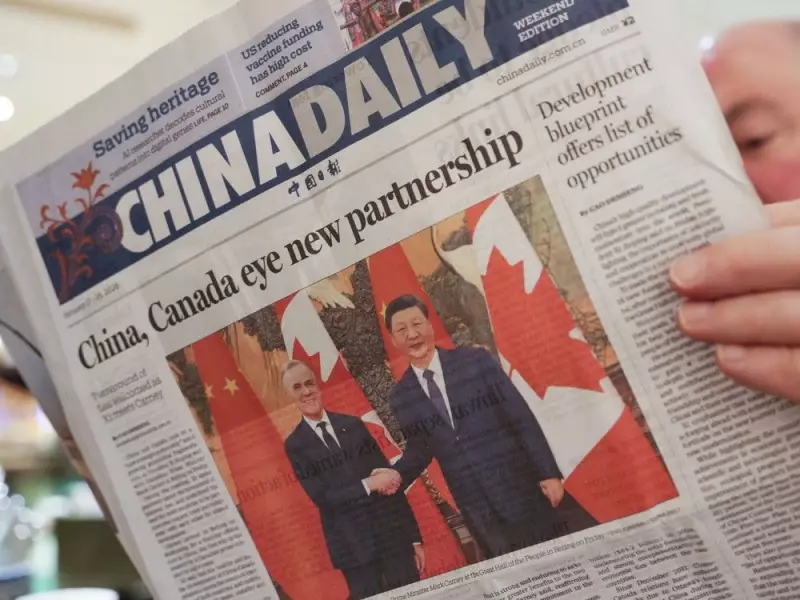
During his visit to China in January 2026, Carney did not misspeak when he praised the concept of a "new world order." Analysts contend he selected his terminology deliberately. However, this language holds an extremely specific and loaded meaning within Chinese strategic doctrine, one that directly contradicts Western liberal norms and signals a challenge to U.S. global leadership.
For Beijing, the phrase is not about reforming globalization. Its core objective is displacing American power, weakening Western alliances like NATO, and replacing the existing international system with a hierarchical model. This model prioritizes state control, non-interference in internal affairs—which often shields authoritarian practices—and rejects universal human rights.

This vision is enforced domestically through policies of mass surveillance, censorship, and the repression of groups including Uyghurs, Tibetans, and pro-democracy advocates in Hong Kong. Internationally, China pursues this order through military pressure on Taiwan, coercion of neighbours like Japan and the Philippines, and the militarization of the South China Sea.
Strategic Fallout with the United States
The timing and location of Carney's comments are seen as particularly problematic. The United States, under both Democratic and Republican administrations, has unequivocally identified China as its principal strategic competitor. Washington now increasingly views allies through a binary lens: those who are aligned and those who hedge their bets.
By appearing to validate Beijing's core strategic narrative, Carney has placed Canada uncomfortably in the "hedging" category. This comes at a moment when Canada has few strong advocates in a hyperactive and unpredictable Washington. The potential response could be tangible and painful, manifesting as tougher questions on intelligence sharing within the Five Eyes network, less patience for Canada's defence spending shortfalls, and a colder assessment of Ottawa's reliability in NORAD.
Further complicating matters, Carney's discussion with President Xi Jinping reportedly touched on sensitive topics like historic U.S. interest in acquiring Greenland. His claim of "much alignment" between Canadian and Chinese views, coupled with a warning that Canada would uphold NATO's Article 5 commitment to Denmark if the U.S. invaded, is unlikely to have improved Ottawa's standing in the American capital.
The Critical Arctic Dimension
The misstep takes on far greater gravity when viewed through the lens of Arctic security. NORAD Commander General Gregory Guillot has publicly warned that both Russia and China are operationally probing Canada's northern defences. Meanwhile, Beijing has branded itself a "near-Arctic power" despite having no Arctic territory—a strategic claim designed to normalize its presence and influence in the region.
China views the Arctic as another frontier for its "new world order," aiming to erode Western dominance, embed economic leverage, and gradually rewrite governance norms. For Canada, this strikes at the heart of its sovereignty. The Arctic represents vital territory, critical infrastructure, and strategic depth for North American defence.
Praising Beijing's worldview while China actively presses its Arctic ambitions creates a stark contradiction for Washington. This contradiction undermines the trust that is foundational to continental security cooperation. With reports that former President Donald Trump is already concerned about the vulnerability of Canada's Arctic to adversaries, the need for clear, consistent messaging is paramount.
Engagement Versus Validation
Defenders of the government's approach will argue that engagement with China is necessary, that trade is important, and dialogue is unavoidable. These points may hold merit. However, critics draw a sharp distinction between pragmatic engagement and the validation of a rival power's hegemonic vision.

Ottawa had alternative paths to strengthen its position, such as deepening engagement with the Trump administration, the European Union, or other liberal democracies. Carney's choice to offer praise in Beijing, however, is seen as a strategic signal.
The fundamental question for Canadians, according to analysts, is why a prime minister would applaud a vision of the world explicitly designed to weaken the very alliances that guarantee Canada's security and prosperity. China's proposed order is not inevitable, benevolent, or neutral. It is actively contested. The Carney government's comments, experts warn, sent exactly the wrong message, to exactly the wrong audience, at exactly the wrong time.