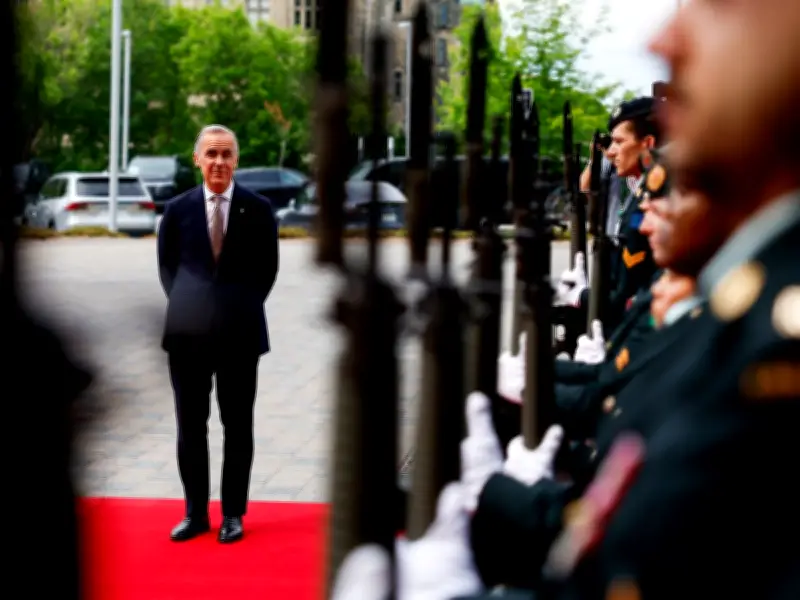
In late May, a South Korean attack submarine slipped into a harbour in Victoria, B.C., serving as a floating sales pitch for one of the largest military contracts in Canadian history. Days later in Ottawa, Germany’s defence minister stood alongside his Canadian counterpart, arguing that the future of Canada’s navy lies in closer alignment with Europe and a German-made sub.
Canada’s $70 Billion Submarine Decision Nears
Canada is close to a decision on who will win the order to build as many as a dozen vessels, and the political and financial stakes are large. One executive involved in the process estimates the contract may ultimately be worth more than $70.4 billion when decades of support and maintenance are included. David Perry, president of the Canadian Global Affairs Institute, said the total cost may approach $120 billion factoring in operation and maintenance.
It’s also a test of Prime Minister Mark Carney’s strategy of leveraging new foreign policy and defense spending into economic gains. The former central banker won power last year by persuading voters he could protect Canada from U.S. President Donald Trump’s tariff assaults by forging stronger relationships with the rest of the world.

Carney’s Pivot to Military Spending
Spending heavily on military equipment and troops is a sharp pivot away from the approach of his predecessor, Justin Trudeau — one Carney hopes to convert into investment and manufacturing and technology jobs. His cabinet has been squeezing the Germans and South Koreans to offer sweeteners in their bids, such as automotive investment, that might help Canada offset the economic damage done by Trump’s trade war.
Like all political strategies, it involves tradeoffs. The submarine decision forces Carney into a choice between a rising Asian economic powerhouse that Canada wants to get closer to, and longtime allies in the North Atlantic Treaty Organization. It will affect the country’s military capabilities, industrial base and alliances for decades.
Bidding War: Hanwha vs. Thyssenkrupp
For months, Canada has been wooed by South Korea’s Hanwha Ocean Co. and HD Hyundai Heavy Industries Co., facing off against a German-Norwegian group led by Thyssenkrupp Marine Systems. Both bidders have put forward sweeping proposals that go well beyond submarines. Hanwha is offering a submarine design already in service, promising faster delivery — a claim it underscored by docking its KSS-III in Victoria. The TKMS bid, centered on the Type 212CD being developed by Germany and Norway, emphasizes interoperability with NATO allies and deeper strategic alignment with Europe, a message reinforced in Ottawa by German Defence Minister Boris Pistorius.
“We’re really looking at cementing a combination of an economic partnership and a strategic political partnership with whoever wins this thing for the next 75 years,” Perry said.