

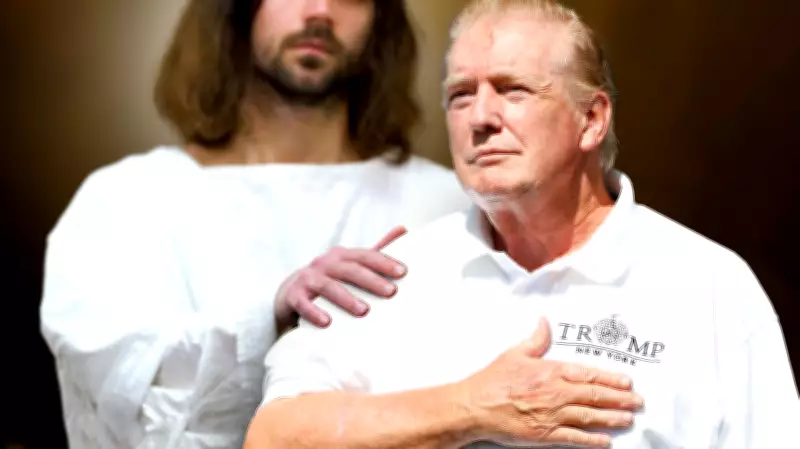
Faith Advisor's Trump-Jesus Comparison Sparks Holy Week Controversy
Paula White-Cain, a senior advisor in the Trump White House Faith Office, ignited a theological firestorm on Wednesday night by drawing direct parallels between the former president and Jesus Christ during a gathering of Christian faith leaders. The comments, made during prayers for Easter, have been widely condemned as blasphemous and historically inaccurate by biblical scholars and religious figures across denominations.
"No One Has Paid the Price Like You"
During the meeting, White-Cain stated: "Jesus taught so many lessons through his death, burial, and resurrection. He showed us great leadership, great transformation requires great sacrifice. And, Mr. President, no one has paid the price like you have paid the price. It almost cost you your life."
She continued with what many interpreted as a comparison between Trump's legal troubles and Christian doctrine: "You were betrayed and arrested and falsely accused. It's a familiar pattern that our Lord and Savior showed us. Because of His resurrection, you rose up."

Biblical Scholars Identify Multiple Inaccuracies
Biblical scholar Aaron Higashi told media outlets that White-Cain's comparison was "factually incorrect" on multiple levels. "There is no comparison between President Trump's arrests and Jesus'. President Trump has been arrested on several occasions, but he's always voluntarily surrendered himself at pre-arranged times where every opportunity is taken to ensure his comfort and quick release," Higashi explained.
"Jesus, by contrast, was ambushed and violently arrested by an armed crowd. He was abused in custody and obviously never released. In the Gospels, we know that Jesus was falsely accused both because Pilate finds no reason to have him executed and because the resurrection vindicates his divine claims and purpose. President Trump has no comparable vindication, either legally or theologically."
Contextual Disconnect Highlighted
Jennifer Bird, Ph.D., a biblical scholar and author, noted the profound contextual differences between the two figures. "So Jesus, the guy, a Jewish guy—some form of rabble rouser, maybe—but certainly what he represented as a human was rejecting the powers that be, rejecting the way the people in charge and religious leaders were in collusion with the Romans and exploiting the people," Bird said.
"To compare the execution of such a person to Donald Trump, who is actually the guy that Jesus would have been speaking out about? We're completely ignoring the whole context of what was going on."
Bird emphasized the fundamental incomparability: "I do think it's perhaps helpful to think about the fact that Trump is a president of the United States. He is a leader on a global level. And Jesus was a person of the masses. From the outset, these are not comparable people in terms of their station in life. These are not comparable life experiences."
Religious Leaders Decry Blasphemy
The comparison drew immediate condemnation from religious figures. James Martin, a Jesuit priest and founder of Outreach, an LGBTQ Catholic ministry, posted: "Asking God, in a public prayer, to help a political leader make wise decisions, care for the poor, seek peace, foster harmony, and try to include all those who feel excluded? Yes. Comparing a political leader, in a public prayer, to the sinless Son of God during Holy Week? No."
Rev. Benjamin Cremer was more direct, calling the comments "blasphemy" and stating: "This is what it sounds like to take Jesus' name in vain."
Connection to Christian Nationalism
Both scholars and religious leaders connected the controversial comparison to the rise of Christian nationalism in American politics. Higashi noted: "Marjorie Taylor Greene and Charlie Kirk both compared President Trump to Jesus in 2023. In my experience, it's not common to see 1:1 comparisons between Jesus and a person of faith because it sounds blasphemous. But with the rise in white Christian nationalism, and the tendency of evangelicals to see government power as a fulfillment of their religious aspirations, the comparison has become more common."

Bird, a former evangelical Christian herself, observed: "I don't know that we made those comparisons 30 years ago because it would be sacrilegious. It would have been sacrilegious to us to compare a person that we liked to Jesus. That would be totally inappropriate. To compare any person to Jesus, when I was in that state, it was heretical: You don't compare people to God incarnate."
Non-MAGA Christians Express Outrage
Malynda Hale, executive director of The New Evangelicals, called the comments "blasphemy" but "not surprising." "It's embarrassing. It's insulting to the foundation of the faith. And it's exactly why people can't be timid about calling out Christian nationalism," Hale said. "I refuse to let people like this redefine my faith into something that centers Trump instead of Jesus."
Hale considered such comparisons to be "what it means to take the Lord's name in vain" and added: "These people worship having so much power they are practically foaming at the mouth about it and they have the audacity to call it faith—and during Holy Week of all times. It just shows how far they are willing to go in order to change Jesus's message so it can serve their political agenda."
"Living up to the actual words and commands of Jesus is hard for them because it requires integrity and accountability. It's a lot easier to reshape Jesus into someone who looks more like the leaders they already want to follow," Hale concluded. "So they elevate Trump to Christ-like status to justify staying aligned with him. That's also why they still have pictures of a white Jesus in their churches and homes. But anyone who truly understands the teachings of Jesus would never do this."





