

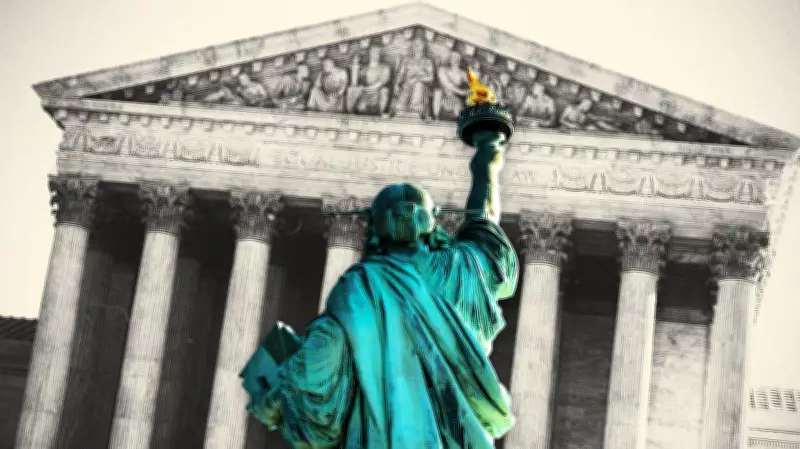
Supreme Court Confronts Fundamental Question of American Identity in Birthright Citizenship Case
This week, the United States Supreme Court engages in a historic deliberation that strikes at the very heart of American identity. The justices are hearing arguments in Trump v. Barbara, a class-action lawsuit challenging former President Donald Trump's executive order that seeks to terminate birthright citizenship for children born to undocumented or temporary resident parents after February 20, 2025. This case questions a principle that has stood unchallenged for over a century: whether individuals born on U.S. soil are automatically American citizens under the 14th Amendment.
High Stakes for Thousands of Families and Constitutional Interpretation
The legal battle carries enormous consequences for countless children and mixed-status families across the nation. Their legal rights and national status hang precariously in the balance as the Supreme Court considers overturning long-established precedent. Cody Wofsy, an American Civil Liberties Union attorney arguing before the Court, warned that accepting the government's position would fundamentally disrupt the nation's understanding of citizenship.
"The arguments that the government is lodging about what it thinks the Constitution supposedly means would cast out the citizenship of millions and millions of people who have lived their entire lives as Americans, potentially going back generations," Wofsy stated. He further cautioned that this case could signal "a kind of open season to question the citizenship of all sorts of folks in this country."

Reinterpreting the 14th Amendment's Critical Language
The Trump administration's executive order hinges on a novel interpretation of specific language within the 14th Amendment. The amendment, ratified after the Civil War to secure citizenship rights for formerly enslaved people, declares that "all persons born or naturalized in the United States, and subject to the jurisdiction thereof, are citizens of the United States." Historically, this has been understood to include nearly everyone under U.S. authority, with only narrow exceptions like children of foreign diplomats.
However, the administration now argues that the phrase "subject to the jurisdiction thereof" refers only to those "completely subject" to U.S. political jurisdiction. Solicitor General John Sauer, representing the administration, contends that undocumented immigrants and temporary residents "do not owe primary allegiance to the United States by virtue of domicile," thus excluding their children from automatic citizenship.
Century-Old Precedent and Congressional Action
This interpretation faces substantial historical and legal obstacles. In the landmark 1898 case United States v. Wong Kim Ark, the Supreme Court ruled 6-2 that a person born in the U.S. to non-citizen parents is an American citizen. Justice Horace Gray emphasized that the 14th Amendment was intended to expand citizenship rights, not restrict them. Congress reinforced this interpretation fifty years later through the Immigration and Nationality Act, which remains law today.
Wofsy criticized the administration's approach, describing it as "the government playing sleight of hand with the term 'allegiance.'" He explained that allegiance, in legal terms, simply means being subject to U.S. laws, which applies to all individuals within the country regardless of immigration status.
Why the Supreme Court Took This Apparently Settled Case
Given this clear precedent, legal observers question why the Supreme Court accepted Trump v. Barbara. Lisa Graves, co-founder of Court Accountability, expressed concern about judicial impartiality. "If this Court were not so far in the tank for Trump, [this birthright case] would be a 9-0 decision against him. This would be a slam dunk," Graves remarked. Her organization reported that in 2025, the Court ruled in Trump's favor in 90% of cases involving his administration.

Trump has consistently targeted birthright citizenship, calling it "a reward for breaking the laws of the United States" and "a historical myth." While lower courts have universally rejected his executive order through injunctions, the Supreme Court now directly addresses the citizenship question after previously ruling on procedural matters in a related case.
Practical Consequences and Human Impact
Reversing birthright citizenship would create widespread confusion and hardship. An estimated 225,000 to 250,000 children were born to undocumented mothers in the U.S. last year alone. Aarti Kohli of the Asian Law Caucus explained that under the current system, birth certificates and Social Security numbers provide straightforward proof of citizenship. If Trump's order is upheld, "parents would have to prove immigration status before their child's citizenship is recognized," relying on notoriously unreliable databases.
This could create a multi-tier system leaving newborns effectively stateless. Kohli emphasized that "birth certificates are how Americans get passports, enroll in school, and access healthcare." Special challenges would arise for children with unknown parents or "foundlings," who might lose citizenship entirely.
Families Living Under Uncertainty
Conchita Cruz of the Asylum Seeker Advocacy Project described how "a cloud hangs over the joy of having a child" for many expecting parents. Families fear detention or separation by immigration authorities despite building lives, careers, and homes in the United States.
One anonymous mother, an international student with a daughter born after the February 2025 deadline, shared her anxiety: "If she thinks she's an American, if there is uncertainty, that's going to impact how her identity forms. Being American is unconditional."
While an injunction currently protects affected children, the Supreme Court's decision will test its commitment to constitutional principles and equal citizenship. As Graves starkly noted regarding the administration's jurisdictional argument: "The legal term for that would be bullshit." The justices now stand at a crossroads, weighing against 160 years of legal tradition that defines American citizenship by birth.





