

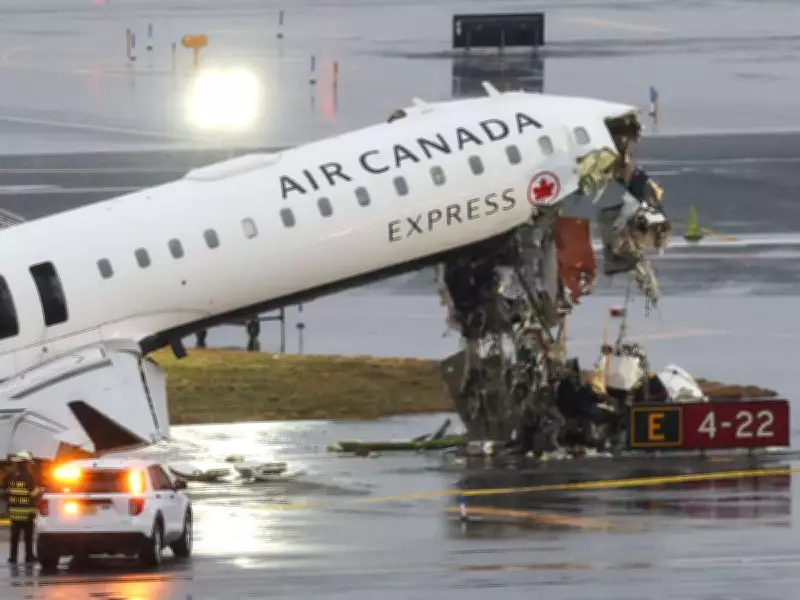
Air Canada Crash Tragedy Ignites Language Controversy Amidst Grief
The aviation community and Canadian public are grappling with both tragedy and controversy following the fatal Air Canada crash at LaGuardia Airport in New York on March 23, 2026. The collision between an Air Canada jet and a fire truck resulted in the deaths of both pilots and injuries to 40 others, creating a moment of profound loss that has now become entangled in linguistic politics.
Condolence Message Sparks Unprecedented Language Debate
In the immediate aftermath of the devastating accident, Air Canada CEO Michael Rousseau issued a public message of condolence delivered exclusively in English. This communication, intended to acknowledge the loss and support affected families, has triggered significant criticism from some quarters who argue it violated Canada's bilingual principles.
Letter writers and commentators, however, are mounting a vigorous defense of Rousseau's approach, arguing that crisis moments demand different standards than routine operations. "When tragedy strikes, judgment must come before procedure," wrote one correspondent, capturing the sentiment of many who believe the focus should remain on the human dimension of the disaster.

The Human Dimension Versus Procedural Perfection
Retired Air Canada executive Samuel Elfassy of Toronto articulated a perspective shared by numerous aviation professionals and observers. "In the first hours after a fatal event, leadership is not measured by procedural completeness," he wrote. "It is measured by humanity, speed, and the ability to acknowledge loss in real time."
This viewpoint emphasizes that crisis communication occurs in what one letter described as "the rawness of those moments" - a context that should inform how such messages are evaluated. The correspondence suggests that immediate expressions of empathy should be understood as attempts to provide comfort rather than polished communication exercises.
Political Dimensions of the Language Debate
The controversy has taken on political dimensions, with some letter writers criticizing what they perceive as opportunistic responses from political leaders. One correspondent specifically mentioned Prime Minister Mark Carney's reaction, characterizing it as "fake outrage to score political points and to protect Liberal votes in Quebec."
This political critique extends to broader questions about Canada's bilingual reality. "Despite what federal legislation may say, Canada, as Selley points out, is for all practical purposes not bilingual," noted one letter, referencing columnist Chris Selley's analysis. "New Brunswick and the federal government may be officially bilingual, but no other jurisdiction in Canada can make such a claim."
The Broader Implications for Crisis Leadership
Beyond the immediate controversy, the correspondence raises significant questions about how society evaluates leadership during emergencies. Multiple letters warn against creating an environment where leaders might hesitate to communicate during crises for fear of procedural criticism.
"If leaders come to believe that even their first expressions of empathy will be immediately judged against procedural perfection, hesitation becomes the safer instinct," cautioned one writer. "And in a crisis, hesitation carries its own cost."
The letters collectively advocate for what they describe as a "more proportionate approach" that recognizes both the importance of official languages and the unique demands of crisis moments. This balanced perspective suggests that while linguistic protocols matter, they should not overshadow the fundamental human response required when lives are lost.
Looking Forward: Lessons from Tragedy
As the investigation into the LaGuardia crash continues and the injured recover, the correspondence suggests several important lessons. First, that society must maintain perspective about what truly matters in the immediate aftermath of tragedy. Second, that procedural improvements should be made thoughtfully rather than reactively. And third, that the standards we set for crisis communication will shape how future leaders respond when lives are on the line.

"If our first instinct in the face of tragedy is to audit language before we honour loss, we should pause and ask what we are really protecting, and what we are quietly eroding," reflected one correspondent, capturing the central tension between principle and pragmatism that this tragedy has revealed.





