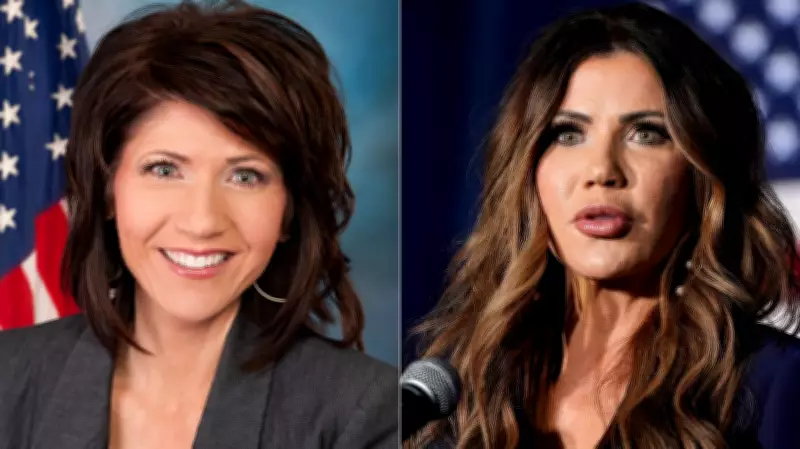
The Rise of 'Mar-a-Lago Face' as a Political Beauty Standard
In the world of MAGA politics, a distinct aesthetic has emerged that goes beyond mere cosmetic enhancement. Dubbed "Mar-a-Lago face" after President Donald Trump's exclusive Palm Beach club, this exaggerated look has become both a status symbol and a visual marker of political allegiance for women climbing the ranks in Trump's orbit.
The Anatomy of a Political Aesthetic
The Mar-a-Lago aesthetic represents a specific constellation of cosmetic procedures that create what plastic surgeons describe as an "uncanny valley" appearance. The transformation typically begins with lip injections, followed by Botox treatments to achieve taut, artificially tight-looking skin. Cheek filler is then employed to restore lost volume in the cheekbones, creating a rounded facial structure.
Complementing these procedures are several mandatory beauty elements: a golden tan (equally prevalent among men in Trump's world), blown-out beachy waves, lash extensions, and veneers. Homeland Security Secretary Kristi Noem notably promoted the clinic where she received her veneers several years ago, highlighting the intersection of politics and cosmetic enhancement.

The final touch involves heavily contoured makeup that some observers have described as drag-adjacent or Kardashian-adjacent. The overall effect is so exaggerated in its femininity that commentators have likened it to gender-affirming surgery and drag performances. As Mother Jones quipped last year, "Here is the gender-affirming care the right can celebrate."
The Economics of Political Appearance
This distinctive look comes with a substantial price tag. Plastic surgeons estimate that the complete Mar-a-Lago makeover can cost upward of $90,000, with expenses potentially reaching $200,000 to $300,000 for those seeking top-tier surgeons or committed to extensive maintenance. The financial barrier to entry may actually contribute to its appeal within certain circles.
Author Shanna Miles observed on Threads that visible lip filler functions as a "class marker" that doesn't necessarily need to look good but must appear "done." This perspective suggests that within MAGA circles, the goal isn't necessarily to look younger but to look expensive—a visual demonstration of financial and cultural capital.
The Psychology of Political Conformity
Ruth Holliday, a professor of gender and culture at the University of Leeds, explains that cosmetic surgery serves a dual function in these contexts: "marking a body as valuable whilst adding value to it." She describes it as an investment that aligns with neoliberal values of self-improvement and readiness for hard work.
Jennifer Newman Keagle, a board-certified plastic surgeon in Los Angeles, notes that the desire to fit in represents a central motivation for women seeking the Mar-a-Lago look. "It's absolutely about feeling like you fit in," she observes, while acknowledging that different geographic areas develop their own distinctive aesthetics.
Keagle typically advocates for a more natural approach she describes as "me but better," preserving some wrinkles and maintaining individual aesthetics. She cautions that completely erasing signs of aging can result in an "abnormal" appearance, noting that "a 60-year-old woman should not have the same face as a teenager."
Political Allegiance Through Aesthetics
Samantha Kwan, an associate sociology professor at the University of Houston, suggests that the Mar-a-Lago aesthetic communicates political allegiance through Trump's preferred visual vocabulary: "hot." By investing significant resources in these procedures and their upkeep, women signal not only status but also devotion to the MAGA movement.
Laurie Essig, a professor and chair of gender, sexuality and feminist studies at Middlebury College, argues that this "highly produced 'mask of femininity' helps prop up the very fragile and also highly produced masculinity of the movement's leaders." She notes that the aesthetic suggests "loyalty and a willingness to submit" to male authority figures.

The strategy appears effective within Trump's sphere, where physical appearance often influences professional opportunities. Reports indicate that former U.N. Ambassador Nikki Haley was reportedly rejected for secretary of state due to Trump's comments about her complexion, highlighting the president's well-documented focus on physical appearance.
The Masculine Counterpart
This phenomenon isn't limited to women. Men in Trump's orbit have also embraced cosmetic enhancement to project hyper-masculine traits. Former Representative Matt Gaetz appeared to have received Botox treatments before the 2024 Republican National Convention, while Politico reported increased demand among politicians for jaw and chin implants—procedures also popular among incels seeking to enhance their dating prospects.
Essig describes this as "sexual dimorphism" achieved through surgery: men appearing hyper-masculine with square jaws and muscular builds, while women present as hyper-feminine through the Mar-a-Lago aesthetic. Both patterns receive reinforcement within Trump's cultural sphere.
Ageism and Lasting Impact
Experts note that the Mar-a-Lago look reflects what Essig describes as "a deep hatred of what women might look like as they age." Women in their 50s, such as 56-year-old Kimberly Guilfoyle and 54-year-old Kristi Noem, feel particular pressure to maintain a youthful appearance within a culture that values youth in women.
The aesthetic has spread beyond political circles, with Washington and Palm Beach plastic surgeons reporting increased demand for the look among non-politician clients. Whether this trend will persist remains uncertain. Keagle predicts a pendulum swing back toward more natural appearances, though she acknowledges the look's durability in certain American subcultures, exemplified by the long-running "Real Housewives" franchises.
As the Mar-a-Lago face continues to evolve as both beauty standard and political statement, it raises fundamental questions about appearance, conformity, and identity in contemporary political culture.