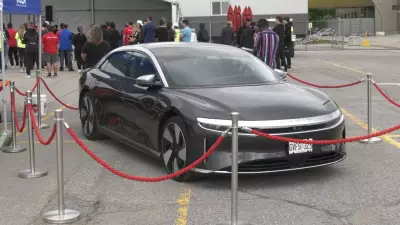
Canadian Industry Minister Melanie Joly has firmly rejected the use of knockdown kits for Stellantis NV to produce Chinese electric vehicles at its idled factory in Ontario, stating that any such plan must have the backing of both the provincial government and the workers' union.
Knockdown Kits Explained
Knockdown kits involve manufacturing the majority of a vehicle in China and then shipping the components overseas for final assembly. This method is currently employed in some of Leapmotor's international operations, as reported by Bloomberg.
Stellantis' Potential EV Production
Stellantis is currently in discussions with Canadian officials regarding the possibility of building electric vehicles in Canada through its Chinese partner, Zhejiang Leapmotor Technology Co. The focus of these talks is the Stellantis assembly plant located in Brampton, a suburb of Toronto.

This plant had a planned Jeep production line that was cancelled last year and relocated to the United States. The decision to move production followed the imposition of tariffs on vehicles manufactured outside the U.S. by President Donald Trump.
Union and Government Opposition
Following the Bloomberg report, both Unifor, the union representing approximately 3,000 laid-off workers at the plant, and Ontario Premier Doug Ford expressed strong opposition to any potential use of knockdown kits. Joly emphasized that she would only support the resumption of production at the Stellantis facility if it received endorsement from both the Ontario government and Unifor.
Joly's Conditions for Support
Joly outlined several criteria for the future of the plant, including the necessity for favorable conditions for workers, which she stated should be at least as good as before, if not better. Additionally, she highlighted that any software used in electric vehicles built in Canada must be secure and compliant with trade agreements signed with the United States.
"We can't bring cars in a kit to Canada," Joly remarked during a press conference in Vancouver on Thursday. "It needs to support the local supply chain."
Broader Implications
This development underscores the ongoing tensions in the automotive industry, particularly concerning international trade policies and the push towards electric vehicle adoption. The rejection of knockdown kits by Joly reflects a commitment to bolstering domestic manufacturing and ensuring that production benefits local economies and workers.
The situation at the Brampton plant remains a focal point for discussions on how Canada can navigate the evolving landscape of global automotive production while safeguarding its industrial interests.