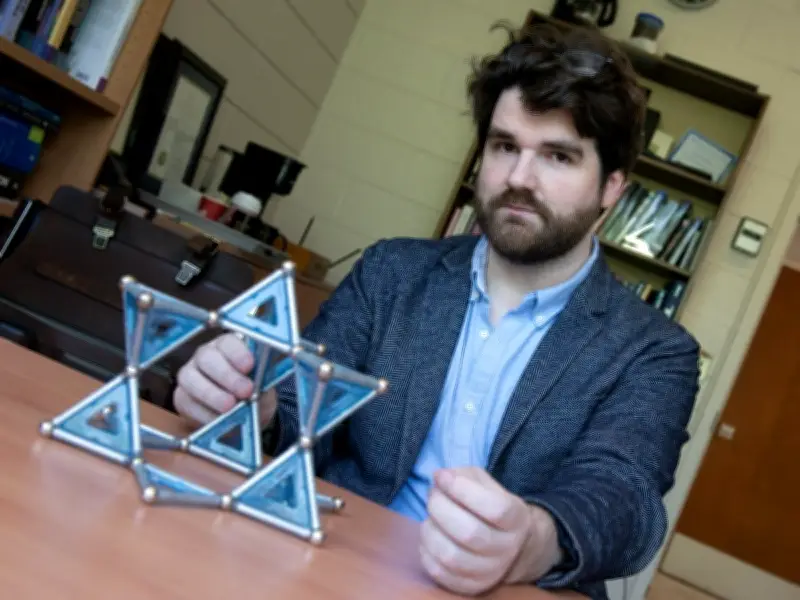
Dr. Jeffrey Rau, an associate professor of theoretical condensed matter physics at the University of Windsor, has been awarded the Gerhard Herzberg Canada Gold Medal for Science and Engineering, the top honor in physics from the Canadian Association of Physicists. The award recognizes his work on magnetism that could lead to more efficient data storage, requiring less power and generating less heat.
Surprise Recognition
“I was somewhat surprised that I actually won it, just because it’s a national level award and it’s for all of physics,” Rau told the Windsor Star. The Herzberg Medal is given annually to an individual whose body of work in natural sciences or engineering has “demonstrated persistent excellence and influence,” according to the Natural Science and Engineering Research Council of Canada.
The Science of Magnetism
Rau’s research focuses on theoretical physics in magnetism, part of condensed matter physics, which studies systems where many atoms interact strongly. He uses math and computer simulations to explore phenomena like a “triangular lattice” of atoms in a crystal, where atomic spins can alter material properties. “My role is to try to figure out what the data is saying,” he explained. His work is foundational, preceding experiments and applications.

Potential Applications
Improved data storage and quantum computing are potential applications, relying on spintronics—an emerging field that uses magnetism from spinning atoms to carry and store information. Rau’s approach could lead to devices that consume less power and generate less heat.
Impact on the University
Steven Rehse, head of the Department of Physics at the University of Windsor and the person who nominated Rau, called the recognition a “big deal for the department.” He said it “increases the reputation of the department and the program across all of Canada,” potentially attracting graduate students and research grants. “In their mind this is a place where serious science is being done,” Rehse added.
Award Details
The medal is named after Gerhard Herzberg, a Canadian physicist who won the 1971 Nobel Prize in chemistry. The award includes a grant of up to $1 million over five years to support research, such as creating scholarships or establishing research chairs. Rau plans to continue his work at the university. “We have a whole bunch of questions to try to answer,” he said. “We’re still trying to understand some of the basic science and fundamentals of these specific materials and these specific ideas, and so I will keep plugging away at that, and hopefully it’ll be useful for the people who are trying to do something useful with it.”