Residents of Toronto awoke on Thursday, January 15, 2026, to a city buried under a thick blanket of snow, with more continuing to fall throughout the day. The significant winter event prompted widespread closures across the Greater Toronto Area, affecting schools, universities, the Toronto Zoo, and even the major Don Valley Parkway due to dangerous black ice.
City Grinds to a Halt Under Heavy Snow
Public transit routes operated by the TTC were disrupted, and airport operations faced challenges as Environment Canada escalated its weather warning from a yellow to a more severe orange alert. The storm system created a familiar scene of winter paralysis in Canada's largest city. However, one historical benchmark was notably not crossed: the city did not have to request assistance from the Canadian Armed Forces for snow removal.
This fact did not go unnoticed, especially as the date coincided almost perfectly with one of Toronto's most legendary weather-related episodes. The memory of that event, from January 14, 1999, remains a staple of Canadian weather lore, a story the rest of the country is always ready to recount to Torontonians.

The Ghost of Blizzards Past: The 1999 Army Call-In
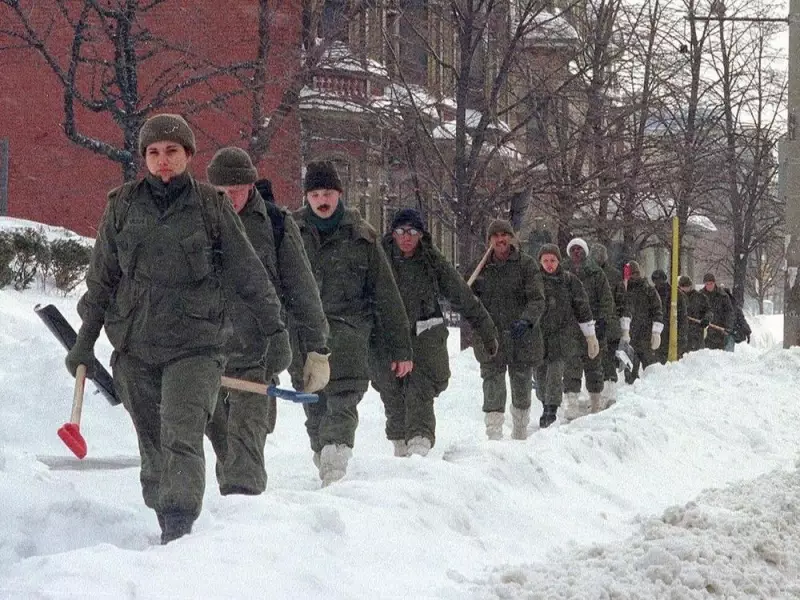
Nearly 27 years to the day prior, Toronto was reeling from a monumental snowfall. A blizzard had dumped a staggering 41 centimetres of snow on the city, part of a larger storm that affected the Quebec-City-to-Windsor corridor and parts of the United States. Chicago received over 50 cm, while South Haven, Michigan, saw more than 70 cm.
Yet, only Toronto took the unprecedented step of calling for military aid. The situation was dire, compounded by the fact that a record 118 cm of snow had already fallen in the first two weeks of January that year. Facing forecasts of another potential 50 cm, then-Mayor Mel Lastman made the fateful call to federal Defence Minister Art Eggleton.
In response, more than 300 local reservists and 438 troops from CFB Petawawa were deployed to help shovel out the stranded city. The image of soldiers from the Royal Regiment of Canada clearing Toronto streets became an indelible part of the national consciousness.
National Reaction and a Lasting Legacy
The 2026 snowfall inevitably sparked comparisons and jokes across Canada, with even tiny Prince Edward Island offering its help in a lighthearted jab. The event serves as a perennial reminder of that unique moment in Toronto's history.
In a 2019 interview marking the 20th anniversary, Mel Lastman defended his decision, emphasizing the public safety crisis. He recounted that residential streets were impassable for emergency vehicles like ambulances and fire trucks. Interestingly, Lastman credited the idea to his wife. "It wasn't me who came up with it," he told the National Post. "It was my wife. When I told her what the heck was going on, she said, 'Call in the army!'"
While the 2026 storm caused significant disruption, it ultimately proved manageable by city services, allowing Toronto to avoid a repeat of its most famous winter chapter. The story continues to be a touchstone for measuring severe winter weather in the city, a benchmark of snowfall so extreme it theoretically requires soldiers with shovels.