Last week at Delaney Hall in Newark, New Jersey, protesters sang at police during a sit-in. This event occurred just months after the Resistance Revival Chorus packed 500 people into Middle Church in Manhattan’s East Village for an ICE Out sing-in. At that February event, 150 people who could not get inside remained on the sidewalk, singing along from printed lyric sheets. Neighbors emerged from their apartments to join them. Hundreds more watched the livestream from across the country. A loud movement is happening, and it is not confined to the New York metro area.
Across the United States, people are gathering in living rooms, churches, city parks, and street corners to learn songs together. These include protest songs, spirituals, civil rights anthems, and new compositions written in direct response to ICE raids and the deaths of Renee Good and Alex Pretti. In Minneapolis, a group called Singing Resistance held its first singing vigil in January, expecting only about 30 people. Instead, 300 showed up. The group now has hundreds of chapters across the country. Other groups around the nation are forming and growing rapidly in response to the current upheaval.
In Portland, Oregon, a singing action group called A Notion, A Scream has grown from 40 to 90 singers in less than two years. “We are not a choir,” says Liz Digitale Anderson, a community song leader in Minneapolis who co-founded Singing Resistance. “We are a mass participation movement trying to stand up to authoritarianism together.”

The Origins of Singing Resistance
The story of Singing Resistance begins, like so many Minneapolis stories lately, with Immigration and Customs Enforcement. When federal agents flooded the city in December 2025 under what the Department of Homeland Security called Operation Metro Surge, Digitale Anderson and a group of fellow community song leaders saw the writing on the wall. They had already been talking to each other, planning actions for early 2026. Then an ICE officer killed Renee Good, and all bets were off.
The first vigil happened shortly after Good’s killing. The idea was simple: learn some songs, walk the streets of neighborhoods where ICE had been most active, stop and bear witness at sites where neighbors had been taken, and sing. “We figure ICE won’t come to the streets if we’re in the streets,” Digitale Anderson says. The group did not expect people to show up, but hundreds poured into the winter streets to sing with them.
“It was just really moving to see people who’d been hiding in their houses. Literally,” Digitale Anderson explains. “We’re delivering groceries to people who couldn’t leave for fear of being kidnapped [and they’re] coming out on their porches. Folks were filming us from their window. Someone held up their puppy.”
The protesters sang songs in English and Spanish, including “No Están Solos,” a song from the Peace Poets, a Bronx-based collective that has been writing movement music and singing across border fences to detained immigrants for over a decade. The lyrics say: “You are not alone. Together, we are securing liberation.”
Weeks later, a text message chain led Digitale Anderson back to a family she had been helping connect to mutual aid. Someone had posted a video of the singing on Facebook with a Spanish caption, and the family had seen it. “They’re like, this is your group. We saw you singing. We saw you out there in the street, standing up for us,” she recalls.
People kept asking, “How do we do this in our city?” Singing Resistance put a toolkit and a songbook online and held mass interest calls. Over 6,000 people came to one of their Zoom trainings. “We now have 300 chapters across the country,” Digitale Anderson says. “People are hungry for a way to be in community with neighbors, and to say: This is not the world we want. We’re building something where everyone gets taken care of.”

Historical Roots of Protest Singing
Singing has served both as a form of resistance and as the connective tissue between activists since abolition. Spirituals were used in the Underground Railroad to encode messages and bring comfort alike. During the Civil Rights Movement, protest songs and freedom songs brought people together. The same is true of basically every sociopolitical movement in U.S. history. In fact, while the Singing Resistance Songbook does include newer songs, a lot are canonical protest songs or modern reinterpretations of older songs. The act of singing together helps people form the emotional bonds necessary to see them through difficulty and, on some foundational level, makes people feel in their bodies that they are in it together. This has always been true.
Portland’s A Notion, A Scream
Three thousand miles away from Minneapolis, in Portland, Lynn Fendler and Julie Earnest, co-founders of A Notion, A Scream, have been building something similar. A Notion, A Scream was founded in September 2024. No auditions. No fees. Everything by donation. They sing music exclusively by living composers, most of whom are Black, Latinx, Indigenous, trans, and/or women.
“The kind of music we sing — combined with our organizational structure and our gift-economy culture — creates for us a reality that rejects the greed of capitalism and the oppression of white supremacy,” Fendler says. “You could call it a kind of counter-programming.”
Every rehearsal begins the same way. The gathering song is called “Welcome Home.” Fendler describes what it feels like when new people are in the room: “No matter who you are, no matter what you’ve done, you are welcome here. When I imagine them hearing that for the first time, surrounded by that, that hits me.”
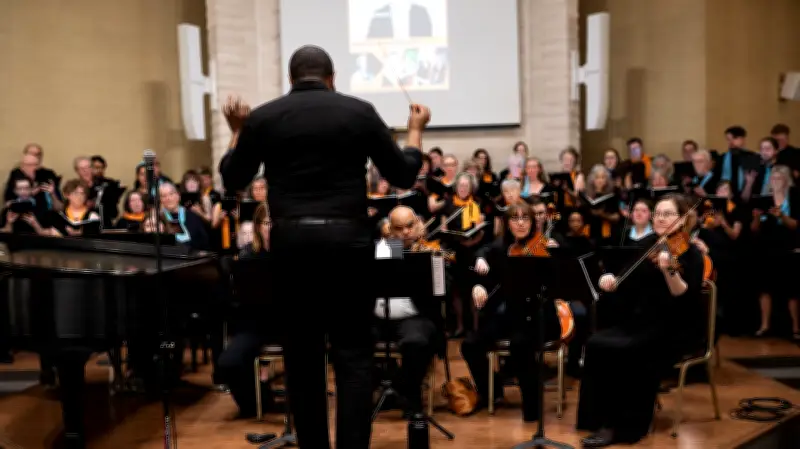
A Notion, A Scream’s first concert was in April 2025, and hosted 290 people, filling every seat the fire marshal would allow. The group’s artistic director and conductor, DeReau K. Farrar — whom Fendler describes as “a man of very few words in front of an audience” — turned to the crowd before a song called “Don’t Be Afraid,” written by composer Allyson Reigh, specifically to encourage and empower trans youth in a high school setting. Farrar began talking to the audience: If you identify as trans and are comfortable standing, he said, please do so. If you identify as having a family member who is trans and are comfortable standing, please do so. If you identify as a person of color. If you identify as queer. On and on he went, Earnest says. “People were standing and standing and standing,” Earnest says. “The whole room was standing by the end of it.” Then the soloist, Bethany Small, had to sing. “Her voice was cracking. It was breaking,” Earnest says. A concert is not supposed to do this. And yet.
Personal Impact and Community Building
Tann Cordell Schneider, a writer in New Orleans, is not in a choir. She does not really do marching. She sometimes sings with an improvised singing group, but it has somehow become a crucial part of her life. “When it feels the most alive and electric, it feels like cleaning out my body. It’s almost like dusting the corners of my body,” she explains. With others, she says, it becomes something larger: “A synergy of group energy that is so much bigger than just one person.”
The effects are not just emotional. They are also practical. “It helps me move through life and anything that feels challenging with a lot more grace or stability. It kind of cuts the bullshit a little bit in this way that I can see more clearly,” she says.
This is what Digitale Anderson was trying to explain about those streets in Minneapolis and what made people who had been chasing ICE cars since dawn finally stop and cry as they sang. It is what Fendler means when she says she walks into rehearsal exhausted and leaves with ten times more energy. What Earnest means when she talks about 290 people standing in a concert hall, a soloist’s voice breaking open, undone by raw feeling.
“Singing together resonates in this moment,” Fendler says, “because it helps us realize that what is most worthwhile is not what white supremacist societies dictate. We feel stronger because we are connected in caring for each other.”