A humpback whale discovered dead this week off a Danish island has been identified as the same animal that was released two weeks ago following a spectacular and contentious rescue operation, authorities confirmed on Saturday. The whale had repeatedly become stranded off Germany's Baltic Sea coast.
Discovery and Identification
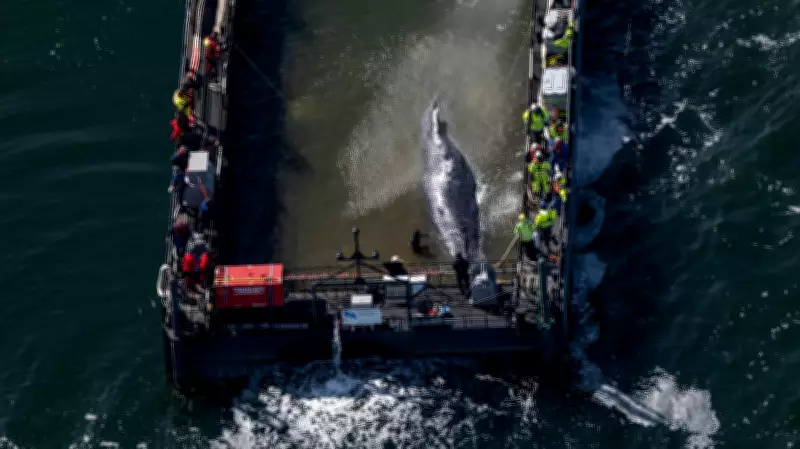
The whale was found stranded on Thursday near the small island of Anholt in the Kattegat, the broad strait between Denmark and Sweden that connects the Baltic Sea to the North Sea. This location is approximately 70 kilometers (45 miles) south of Skagen, on Denmark's northern tip, where the whale — nicknamed "Timmy" and "Hope" — was released on May 2 after being transported toward the North Sea on a barge.
Jane Hansen, head of division at the Danish Environmental Protection Agency, stated in an emailed release: "It can now be confirmed that the stranded humpback whale near Anholt is the same whale that was previously stranded in Germany and was the subject of rescue attempts." She added that favorable conditions on Saturday allowed a Danish Nature Agency employee to locate and retrieve a tracking device still attached to the whale's back. "The position and appearance of the device confirm that this is the same whale that had previously been observed and handled in German waters," Hansen said.

A Lengthy Drama Unfolds
The whale was first sighted off the German coast on March 3. Experts remain uncertain why it entered the Baltic Sea, far from its natural habitat, though some suggest it may have lost its way while chasing a shoal of herring or during migration. In late March, it was rescued from shallow waters in Timmendorfer Strand using an excavator, but soon encountered difficulties again nearby. Local media provided days-long live streams, and news sites tracked every development in the whale's plight.
By early April, experts had abandoned hope, predicting the whale would die in the inlet where it was stranded. However, the animal's deteriorating condition sparked a controversy involving privately funded rescuers, regional authorities, and scientists. Activists staged protests demanding rescue, while influencers debated the best approach. Some scientists argued that further rescue efforts would cause severe stress to the already ailing and exhausted animal.
Rescue Attempt and Aftermath
The regional government in Germany's Mecklenburg-Western Pomerania state permitted a private rescue initiative to proceed with the ambitious plan to pull the whale onto a flooded barge. The initiative confirmed that the tracking device number on the dead animal matched the one attached to the whale, according to German news agency dpa. It noted that the exact cause of death could not be determined conclusively.
Lessons Learned
Mecklenburg-Western Pomerania's environment minister, Till Backhaus, remarked on Saturday that the effort gave the whale "a last chance to recover its freedom and health," but it was unable to seize that opportunity. He emphasized the importance of learning "the best possible lessons" from the episode. Backhaus stressed in a statement that "acquiescing to the rescue attempt doesn't constitute criticism of science" and added: "I think it is absolutely human to use even the smallest chance when a life is at stake."
Authorities have not yet decided how to handle the carcass. Hansen stated that "at this time, there are no concrete plans to remove the whale from the area or to perform a necropsy, and it is not currently considered to pose a problem in the area." However, she warned people to stay away due to potential disease risks and other concerns.