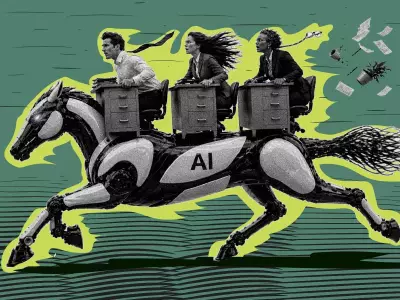
Speaking two languages has long been essential for some leadership roles in Canada. Whether running for prime minister or leading a national airline, bosses have ignored bilingualism at their peril. Today, an arguably greater bilingualism imperative is emerging. The workers who will thrive in the next decade will be fluent in both domain expertise and AI.
There is huge risk for both companies and employees who don’t keep up with the AI transformation of business, writes Andrew Graham. The need for virtually every white-collar worker to gain AI skills is one of the most significant and sudden workplace shifts we’ve ever experienced. Large language models that emerged just a handful of years ago are evolving at a breakneck pace. Their impact has already been transformative in some professions. AI is drafting contracts, handling customer support calls and coaching salespeople.
It’s hard to overstate the speed at which this change is happening. Take, for example, the role of a software engineer. Just a few years ago, it typically meant writing code. As coding tools like Cursor and Copilot emerged, much of software development shifted to prompting tools to write code. Now, the cutting edge of software engineering is about having an architectural vision and managing teams of AI agents to achieve it.

What does this look like in practice? Think of the human as technical director managing a squad of specialized contractors, each running semi-autonomously on discrete tasks. One agent writes the code, another reviews it, another tests it, another writes documentation explaining how it works, and so on.
There is huge risk for both companies and employees who don’t keep up. We’re entering an era where using AI tools is becoming table stakes for many job applicants. This is not a static educational requirement: The most successful employees and companies will demonstrate an aptitude to continuously learn, upskill and retool. Here’s a rule of thumb: if a role requires proficiency with email today, it will require proficiency with AI very soon.
So whose job is it to teach workers to use AI? Employers need to take the lead, for two reasons. First, adoption of AI is emerging as a competitive advantage for companies. McKinsey estimates that generative AI represents a potential $4.4-trillion annual worldwide productivity boost, roughly four per cent of global GDP. But the competitive window is closing quickly, with early adopters positioned to capture outsized value while late movers risk lasting disadvantages.
Second, employers have a responsibility to their people. The workforce is starting to bifurcate between those with AI skills and those without. According to a study by PwC, workers with AI skills command wage premiums up to 56 per cent higher than their peers. LinkedIn’s 2025 Workplace Learning Report placed AI fundamentals among the top skills most likely to trigger internal promotions. Professionals who added at least one AI competency experienced a 40 per cent higher promotion rate.