Bumper Berry Harvest Sparks Rare Romance for New Zealand's Flightless Kakapo Parrot
In a remarkable turn of events for conservationists, a bountiful berry harvest across New Zealand's forests has put the nation's peculiar flightless parrot, the kakapo, in a rare and amorous mood. This unusual phenomenon offers a glimmer of hope for the critically endangered species, whose population numbers remain perilously low.
A Feast Fueling Fertility
The Department of Conservation in New Zealand reports that an exceptionally abundant crop of rimu and other native berries this season has provided the kakapo with an unprecedented food source. This nutritional bounty appears to be directly influencing the birds' reproductive cycles, triggering breeding behaviors that are seldom observed. For a species where breeding events, known as "masting," historically occur only every two to four years when specific trees fruit, this season's surplus is a significant anomaly.
"When food is plentiful, it signals to the kakapo that conditions are ideal for raising chicks," explained a conservation biologist familiar with the program. "This berry bonanza is like a green light for romance in their world." The extra energy from the berries is believed to enhance the health and vitality of the females, making them more receptive to mating and better equipped for the demanding task of egg incubation and chick rearing.

Spotlight on Success: Kohengi and Her Eggs
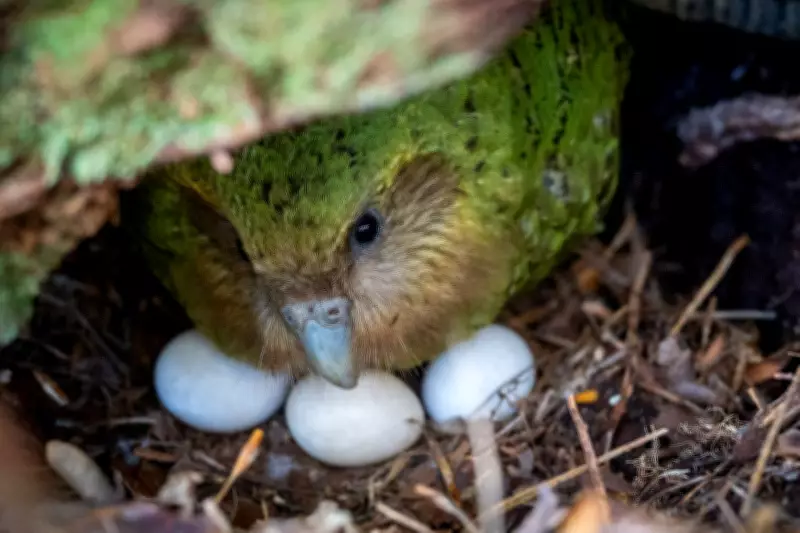
Evidence of this breeding surge is already visible. On Anchor Island, a key sanctuary off the coast of New Zealand's South Island, a female kakapo named Kohengi has been photographed tenderly guarding a clutch of three eggs. The image, captured on February 3, 2026, and provided by the Department of Conservation, symbolizes the potential success of this season.
Kohengi's story is particularly poignant. Each kakapo egg represents a monumental achievement for conservation teams who monitor the birds 24/7 using smart transmitters and nest cameras. The intensive management program includes:
- Round-the-clock monitoring of nesting females.
- Supplementary feeding to ensure optimal nutrition.
- Predator control on offshore sanctuary islands.
- Genetic management to maintain population diversity.
This hands-on approach has been crucial in pulling the kakapo back from the brink of extinction.
The Plight and Promise of the Kakapo
The kakapo (Strigops habroptila) is a biological marvel—the world's only flightless parrot, nocturnal, and one of the longest-living bird species. However, its unique traits also made it vulnerable. Introduced predators like rats, stoats, and cats decimated populations after human arrival in New Zealand. By the 1990s, the species was reduced to a known 51 individuals.
Decades of dedicated conservation work have slowly increased that number. The current population, while still critically endangered, is a testament to these efforts. Seasonal events like this bumper berry harvest are natural catalysts that conservationists eagerly await, as they can lead to a substantial boost in chick numbers.
Scientists are cautiously optimistic. While the berry harvest is a positive trigger, the path from egg to independent juvenile is fraught with challenges. The coming months will be critical as conservation staff support the nesting females and any resulting chicks through their vulnerable early life stages.
This natural bounty, combined with human stewardship, writes a new chapter in the kakapo's survival story—one where a simple berry can be the seed of hope for an entire species.