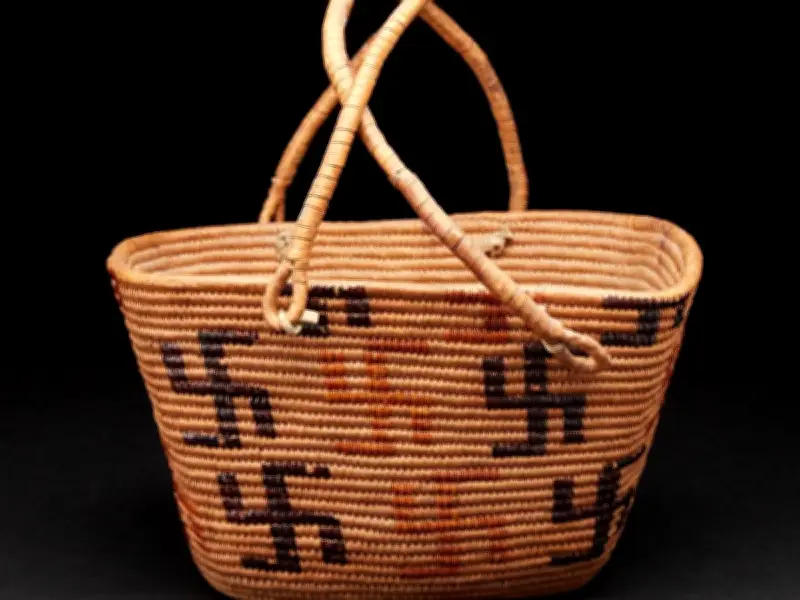
A Nlaka'pamux basket from around 1900, bearing a motif resembling a swastika, is currently listed in a Toronto auction. Experts emphasize that the symbol predates the Nazi era and holds deep cultural significance for Indigenous peoples.
Auction Details and Symbolism
The basket, designated as Lot 31 in Waddington's Discover Inuit and First Nations Art sale, carries an estimate of $500 to $700 and a starting bid of $400. As of Tuesday, no bids had been placed. The auction closes June 25. The catalogue describes it as a basket with imbricated geometric designs but does not address the symbol's history.
Richard Robertson, director of research and advocacy at B'nai Brith Canada, stressed the responsibility of sellers to provide context. "Those selling items like this should be clear about what they are," he said. "There's a responsibility to make clear that this basket contains sacred symbols of a First Nations people. Informing individuals helps change the narrative."

Waddington's did not respond to multiple requests for comment.
Historical Context of the Swastika
The swastika has been an auspicious symbol for thousands of years, sacred in Hinduism, Buddhism, and Jainism, and used as a good-luck sign across Europe, Asia, and the Americas. By the early 1900s, it was a common motif in the West, appearing on advertising and jewelry.
Swastika-like designs arose independently in cultures worldwide, including among Indigenous peoples in the Americas, long before the Nazis adopted the emblem. Among the Nlaka'pamux, the design was recorded as "caterpillar" in research from around 1900.
Nlaka'pamux Basket-Making Tradition
Nlaka'pamux basket-making is a designated national historic event in Canada. Women traditionally wove these baskets from split cedar root with cherry bark using imbrication, a technique where bark is folded under each stitch, creating a raised design. The materials for Lot 31 align with this tradition. After 1850, many baskets were made for trade as colonial disruption reshaped Indigenous economies.
Sharon Fortney, senior curator of Indigenous collections, engagement, and repatriation at the Museum of Vancouver, explained the symbol's deeper roots. "The design on the basket was unfortunately appropriated as a symbol of Nazi Germany but is a design that sometimes appears on Indigenous objects from the Plateau region of B.C. and was also used by various tribes in the United States," she said in an email.
Fortney noted that among the Nlaka'pamux, the design has been described as representing balance, harmony, the four directions, and the four winds. She has seen it on moccasins and other personal items, including a basketry-covered jar at her museum with a faded version of the same motif.
Distinguishing Symbols
Robertson clarified that the Nazi symbol is distinct. "The Nazi symbol is actually the Hakenkreuz, or hook cross, a symbol of Christian Germanic origin that is different from the swastika or the First Nations symbol. It was adopted by the Nazi Party as it rose to power before the Second World War."
The auction continues to draw attention to the need for cultural sensitivity and historical accuracy in the sale of Indigenous artifacts.