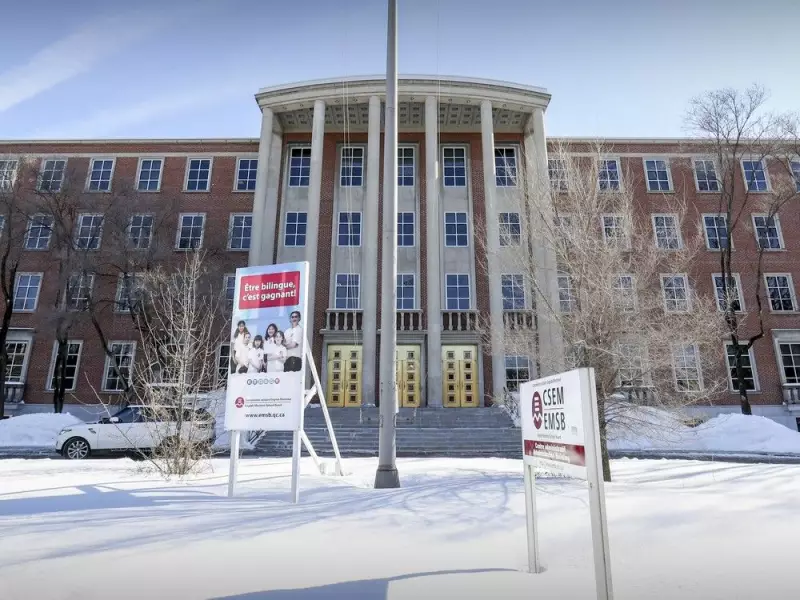
Secretary's Language Complaints Spark Legal Challenge to Quebec's Language Regulations
Complaints from a secretary at an English high school regarding English-only internal emails initiated a sequence of events that culminated in a judicial suspension of specific provisions within Quebec's language legislation. These provisions were originally designed to strengthen the use of French in workplace environments across the province.
Documentary Evidence Reveals Board-Watchdog Conflict
The complete narrative unfolds across more than four hundred pages of English Montreal School Board documents and court filings, which The Gazette secured through an access-to-information request. These records illuminate the ongoing dispute between the EMSB and the Office québécois de la langue française concerning English usage. They also detail the board's attempts to comply with language obligations while simultaneously contesting the Quebec government's regulations in court.
The secretary, whose identity and school remain confidential in the released documents, submitted internal complaints on at least four separate occasions during August and September of 2023. She consistently demanded that emails covering subjects like workshops, team-building activities, mail, and English eligibility certificates be communicated to her in French. She explicitly referenced the Charter of the French Language, widely recognized as Bill 101, to support her position.

"Emails providing instructions must be sent to me in French, as mandated by law," she communicated to an administrator via email. In a subsequent message directed to Nathalie Lauzière, the board's secretary-general, the secretary inquired: "The EMSB is appropriately defending its rights against the Quebec government. However, it must also guarantee compliance with Quebec regulations. Who should I contact to ensure that my fundamental right to work in French is upheld?"
Administrative Confusion and Official Guidance
An EMSB administrator who received these complaints also sought clarification. "When we distribute messages or surveys to parents and the community, we consistently provide both language versions," she wrote to Lauzière in French. "But when I simply need to send a reminder to secretaries about directives or an invitation to a training session, must these emails now be translated into both languages? Not every member of my team feels confident composing emails in French."
Lauzière, a francophone, responded to the secretary in French, acknowledging "the EMSB is proud of its numerous initiatives to promote the French language and thanks you for your efforts in this regard." She indicated that the EMSB would seek guidance from Quebec's language watchdog regarding the matter.
In a separate correspondence, Lauzière forwarded an entirely English email about board procurement procedures to an OQLF official. She noted that the EMSB's legal department believed this email might qualify under the "pedagogical communications" exception within the charter, potentially permitting it to be composed solely in English.
Language Watchdog's Interpretation Triggers Legal Action
On September 29, 2023, OQLF francization adviser Marjorie Cloutier-Lapointe responded to Lauzière, stating that "it is clear to me that this is an administrative communication" since it was unrelated to teaching. She clarified that under the charter, English school boards may use English "in their communications connected with teaching" without requiring a French translation. However, administrative communications—such as school supply lists, registration procedures, and newsletters—fall under a different section of the charter and must be presented in French, though English may also be included.
Cloutier-Lapointe's comments raised significant concerns at the EMSB. They were reviewed during the subsequent meeting of the council of commissioners, the elected body governing the board. Although the EMSB had already initiated a lawsuit against Bill 96, the Legault government's legislation that introduced additional English restrictions to the charter, that constitutional challenge was expected to take years to resolve.

During their November 7, 2023 meeting, the commissioners determined that the OQLF's email necessitated immediate action. They voted to petition the courts to suspend specific sections of the charter while the initial lawsuit proceeded. In a motion approved that evening, the commissioners argued that the OQLF's "interpretation of Bill 96 and the charter" would "effectively require that most internal written communications at the EMSB be conducted in French."
They contended this would undermine the board's "needs and priorities," alter its "linguistic culture," and cause "irreparable harm" to the English-speaking community. EMSB chair Joe Ortona stated at the time that the OQLF's position implied principals of English schools writing to English-language arts teachers about training or to parents regarding a school carnival would be compelled to communicate in French.
Judicial Ruling Provides Partial Victory
Citing constitutional protections for minority-language communities against government interference in their "linguistic and cultural concerns," the commissioners unanimously decided to commence legal proceedings. The EMSB indicated its new legal challenge would also contest new charter provisions requiring English boards to communicate with "key institutions of the English-speaking community," such as the Quebec English School Boards Association, exclusively in French.
The EMSB grounded its arguments on minority-language education guarantees within the Canadian Charter of Rights and Freedoms—the same constitutional provision central to its four other legal challenges against Quebec. When the legal challenge was announced, the OQLF dismissed the EMSB's concerns, informing The Gazette that no changes had occurred to charter requirements or the OQLF's interpretation concerning English boards' communications.
In court, the watchdog later presented evidence showing it had informed the EMSB about what it considered pedagogical material back in 2009. The Quebec government argued that English boards' administrative communications and staff work language are not protected under the Canadian Constitution, asserting it only safeguards parents' and students' rights to education in their language.
Five months later, in April 2024, Quebec Superior Court Justice Suzanne Courchesne granted the EMSB a partial victory. She ruled that specific sections of the charter would not apply to English school boards until the primary legal challenge progresses through the courts. The suspended provisions pertained to the language of certain communications, as well as contracts and contracted services.
Courchesne's decision means six articles of the charter currently do not apply to English boards, "with the exception of situations where the partner or contractor of the board requires the use of the official language." The judge determined that the board's claim—that certain French-only administrative and communication rules could infringe on minority-language management rights—presented "a serious question" justifying temporary relief.
The suspension will remain effective until the courts adjudicate the merits of the EMSB's legal challenge, which has not yet been heard. Notably, Courchesne did not suspend the section of the law concerning internal communication at English boards—the very origin of the secretary's complaints. The judge found the EMSB's assertion that the OQLF had recently restricted the interpretation of "pedagogical" communications was not convincingly substantiated by evidence.
Broader Context of Language Tensions
Courchesne concluded that while English boards might encounter practical inconveniences, no irreparable harm existed to justify suspending those language provisions during ongoing litigation. The Gazette submitted the access-to-information request to the EMSB in 2024, seeking all communications between the board and the OQLF regarding English usage on school board websites and in emails, letters, and contracts.
The board initially declined to release the documents, citing confidentiality concerns. The Gazette subsequently filed a complaint with Quebec's access-to-information commission. The board released the records recently, just days before the commission was scheduled to conduct a hearing on the matter.
The EMSB—Quebec's largest English school board, serving approximately 44,000 students—has frequently clashed with the Coalition Avenir Québec government and is currently engaged in five lawsuits against the province. Anglophone groups argue the CAQ has targeted English education at all levels to advance French language interests.
Quebec is pursuing the elimination of elected English school boards. It has also implemented restrictions on English CEGEPs and enforced a university tuition policy for out-of-province and international students that particularly affects Concordia and McGill universities.
Additional Points of Contention Revealed
The documents obtained by The Gazette further expose specific friction points between the EMSB and the OQLF. In a 2024 sworn statement for the EMSB's court challenge, Jérémie Bigras of the OQLF suggested English school boards "could meet French-language requirements by using free or low-cost translation software." He evaluated the translation of seventeen sample EMSB documents using tools like Google Translate, DeepL, ChatGPT, and Microsoft Word, deeming the results "acceptable to the OQLF."
This stance did not align with Nathalie Lauzière's perspective. In her subsequent sworn statement, she expressed surprise at Bigras's assessment, particularly regarding a translated 255-page guide to the board's banking and budgeting procedures. "This statement is at odds with what I had understood the OQLF's purpose to be," Lauzière wrote. "It endorses mediocrity—at best—in terms of quality of written French, which is not something we do or would do at the EMSB."
Seventeen language complaints were lodged against the EMSB between 2008 and 2024, according to an OQLF court filing. A majority—twelve—were submitted after the Coalition Avenir Québec assumed power in 2018, a period during which the government has encouraged public complaints and modified rules to allow anonymous submissions.
Among these complaints was one filed in December 2021 concerning "the exclusive use of English during an association-hosted dinner" at the EMSB's St. Pius X Career Centre, which operates a professional cooking school program. Other alleged misuses of English involved emails, mass mailings, websites, signage, phone greetings, COVID-19 bulletins, and customer service interactions.
Since taking office in 2018, the Legault government has heavily emphasized protecting French. The OQLF's budget has more than doubled to forty-nine million dollars, and staffing has increased over eighty percent to 398 full-time equivalents. Language complaints have surged dramatically, with 10,371 filed in 2024-25—a fourteen percent increase over the previous year and more than triple the number received a decade earlier.
Linguistic Analysis Requests and Compliance Questions
Quebec's language watchdog has requested a detailed analysis of the EMSB's "linguistic situation" on two separate occasions. In December 2021, the school board was instructed to complete a comprehensive, twenty-page form titled Analysis of Linguistic Situation, according to an EMSB court filing. The board was informed that after submission, the OQLF would either issue a certificate of compliance or request corrective measures.
The questionnaire covered an extensive range of topics, including staff French proficiency and the language of internal documents, social media posts, signage, contracts, purchasing, services to parents, and employees' language use during meetings and conferences. A thorough inventory of hardware and software utilized by administration, staff, and teachers was also required.
Ten months later, in October 2022, EMSB officials were nearing completion of the required information compilation when the OQLF notified the board that it needed to fill out a different form, as indicated in a sworn statement by Lauzière. The new form, also titled Analysis of Linguistic Situation, spanned twenty-two pages. Some questions were expanded, and new inquiries were introduced, including questions about the EMSB's use of the OQLF's approved list of technical terms and Quebec place names, and requirements for EMSB employees to use languages other than French.
The EMSB submitted the completed form to the OQLF in April 2023. The outcome of this submission remains unclear. "To date, I have received no further response or follow-up from the OQLF regarding the EMSB's analysis of its linguistic situation," Lauzière stated in her affidavit dated December 15, 2023. A recent search of the OQLF's database of certified government bodies indicates the EMSB does not currently hold a certificate of compliance.