The Schulich School of Engineering at the University of Calgary recently hosted its annual Engineering Design Fair, a vibrant celebration of student ingenuity and technological advancement. This event provided a platform for nearly 150 projects developed by teams of up to six students, serving as a capstone to their academic studies while allowing them to demonstrate creativity and practical application of engineering principles.
Showcasing Future Engineers
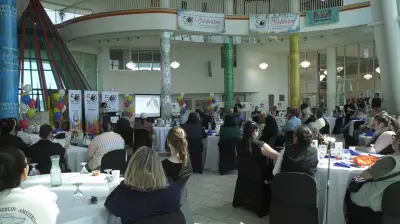
Hundreds of spectators gathered in the atrium of the Calgary Centre for Innovative Technology to witness the culmination of up to ten months of dedicated work by aspiring engineers. The fair highlighted the potential of these students to shape the future through innovative solutions to real-world challenges.
Notable Projects on Display
Among the diverse array of exhibits, three projects stood out for their ingenuity and potential impact:

- A robot arm with human dexterity systems designed for hazardous environments
- A flexible tensegrity underwater vehicle mimicking marine life
- A button-controlled hockey shooting device for sports applications
Robot Arm with Human Dexterity Systems
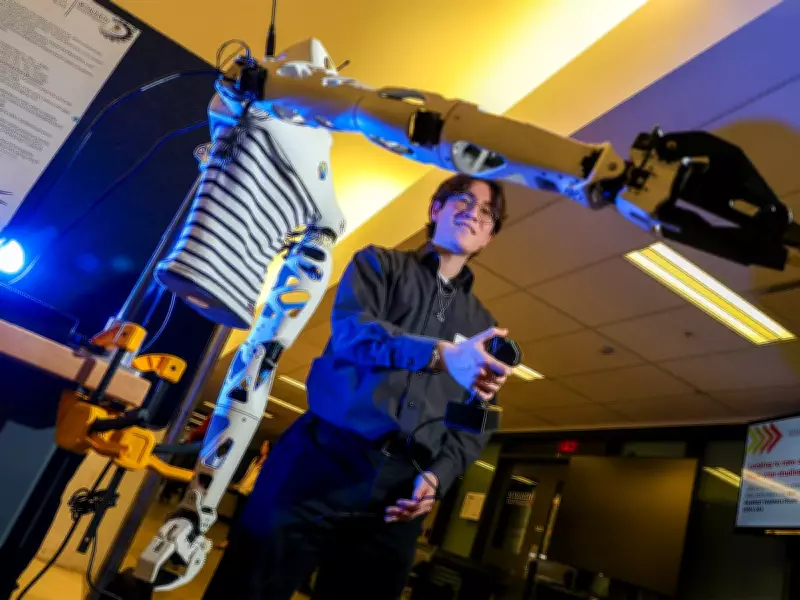
At Booth 131, a team presented a robotic system that appeared straight out of a science fiction film—a white robot adorned in a striped shirt, waving its arms while mounted on a table. The primary function of this innovation is to protect human workers from danger in high-risk settings.
Electrical engineering student Devon Osmar, who collaborated with teammate Ana Florez on the attachment mechanism and controller, explained the project's core objective. "What we have here is a system that's designed specifically to apply human motion to a robot that we can put into hazardous environments," Osmar stated.
The initial vision focused on applications in high-voltage scenarios, such as switch gear and transmission line work, where short circuits can cause dangerous flashes and explosions. "Some of the people currently working in these fields wear almost a bomb squad-looking suit just to turn things on," Osmar noted, emphasizing the need for safer alternatives.
Advanced Sensor Technology
With technology sponsorship from Zero Key, the team integrated sensors capable of mapping human arm motions with precision. This allows operators to control the robot through natural arm movements rather than traditional controllers, enabling exact manipulation for complex tasks.
"Our goal was to create attachments that could interchange easily," Osmar elaborated. "Ideally in the field, autonomously by the robot. So, the robot would have a tool belt." The system demonstrated remarkable accuracy, opening and closing scissors with millimeter-level precision, and the technology is adaptable to various robotic frameworks.
Flexible Tensegrity Underwater Vehicle
Another team developed an underwater vehicle that diverges from conventional robotic designs by replicating the anatomy of a manta ray. This flexible tensegrity structure offers enhanced maneuverability and efficiency for marine operations, showcasing bio-inspired engineering at its finest.
The fair not only highlighted technical achievements but also underscored the collaborative spirit and problem-solving skills essential for the next generation of engineers. As these students transition from academia to professional practice, their innovations promise to contribute significantly to technological progress and safety improvements across multiple industries.