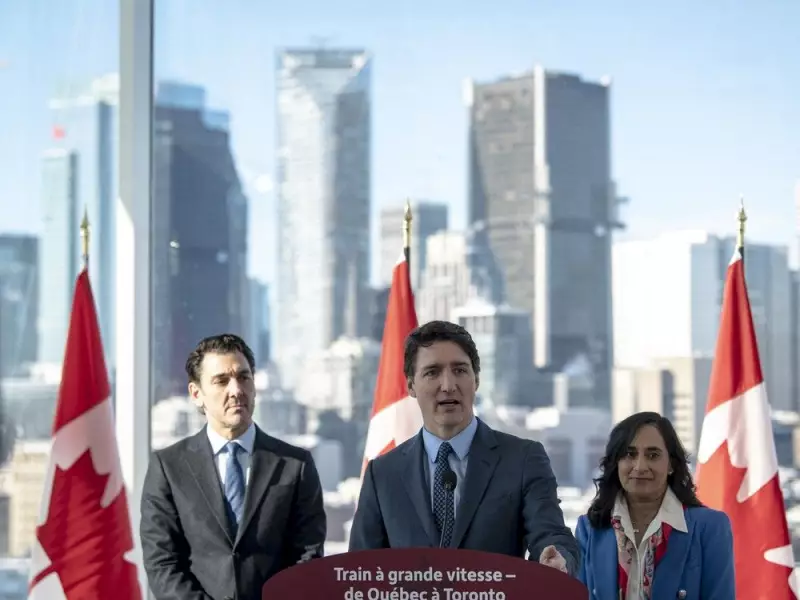
The Canadian federal government has officially set in motion one of the most ambitious and costly infrastructure projects in the nation's history: a high-speed rail network connecting Toronto and Quebec City. Announced with fanfare in Montreal, the project promises to revolutionize travel in the Windsor-Quebec City corridor but comes with a staggering estimated cost of $80 billion and a projected 44-year period to pay for itself.
The Route and The Rationale
This transformative transit link, championed by the federal government and led by VIA Rail's subsidiary, Alto, aims to connect major urban centres with trains travelling on dedicated tracks at speeds between 300 and 350 km/h. The planned stations include Toronto, Peterborough, Ottawa, Laval, Montreal, Trois-Rivières, and Quebec City.
Notably, Laval is slated for two stations due to the north-shore routing of the tracks—one for eastbound trains towards Quebec City and another for westbound services to Ottawa. The primary drivers for the project are to increase reliability by separating passenger service from freight traffic, reduce greenhouse gas emissions by the equivalent of 100,000 cars annually, and provide a competitive alternative to air travel when factoring in airport procedures.

Financing and a Four-Year Deadline
The monumental undertaking is structured as a public-private partnership. Alto has already secured $3.9 billion in initial funding commitments from a consortium of private players, including French rail giant SNCF, Air Canada, engineering firm AtkinsRéalis, and CDPQ Infra, the builder behind Montreal's REM.
As of mid-December 2025, the first segment—the Ottawa-Laval-Montreal portion—has received the federal green light. This section, representing about a quarter of the total 1,000-kilometre network, was prioritized for its relatively straightforward geography. The consortium now faces a hard deadline: it has four years to finalize plans and break ground, pushing the start of construction to late 2029 or early 2030.
Skepticism and Historical Context
Despite the bold vision, significant questions loom. Key details like ticket prices and final service frequency remain unanswered. The most pressing concern is the astronomical price tag, which critics argue could divert crucial funds from other under-financed transit projects across Canada.
This is not Canada's first flirtation with high-speed rail. Proposals and studies date back to the 1970s, including a short-lived "turbo train" service that was hampered by shared, poor-quality tracks. The current project's scale and cost invite scrutiny over whether it is a visionary leap forward or a fiscal pipe dream. Public consultations and detailed route studies are the next steps as the four-year clock starts ticking on this potential legacy project.