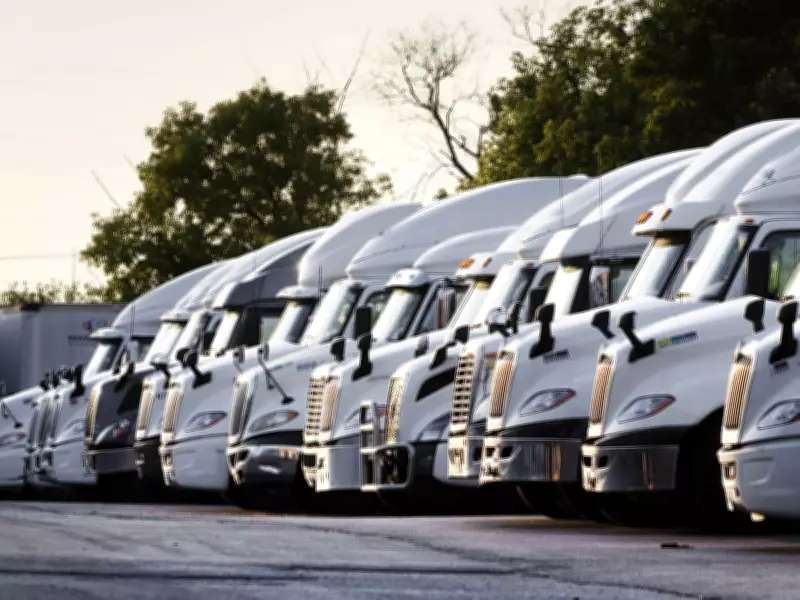
Logistics Stocks Plummet as AI Fear Trade Targets Transportation Sector
Thursday's market session delivered a stark reminder that no sector remains immune to the artificial intelligence anxiety currently sweeping through financial markets, as logistics and transportation stocks became the latest casualties in what analysts are calling the "AI scare trade."
Transportation Index Suffers Worst Day Since Tariff Implementation
The Russell 3000 Trucking Index plunged 7.8 percent during Thursday's trading, marking its most severe single-day decline since former President Donald Trump implemented his so-called Liberation Day tariffs last year. The selloff was particularly brutal for major industry players, with CH Robinson Worldwide Inc. plummeting by a record 24 percent at one point, while Landstar System Inc. dropped 18 percent.
The contagion spread beyond pure transportation companies, with drug distribution stocks also caught in the downward spiral. McKesson Corp. and Cardinal Health both slid more than four percent as investors fled anything perceived as vulnerable to AI-driven disruption.

European Logistics Firms Follow Suit in Global Selloff
The AI-induced panic wasn't confined to North American markets. In Europe, Denmark's DSV A/S fell as much as 15 percent before closing down 11 percent in Copenhagen trading. Swiss logistics giant Kuehne + Nagel International AG experienced similar turbulence, sliding as much as 14 percent and finishing the session down 13 percent in Zurich.
Christopher Kuhn, a Benchmark analyst covering trucking stocks, explained the sector's vulnerability: "The worry is that AI could dis-intermediate the truck brokers, which is why they're getting hit so much. The whole sector is getting hit, but it's mostly on the broker side."
Small AI Logistics Firm Sparks Widespread Panic
The Thursday rout was triggered by an announcement from tiny AI logistics firm Algorhythm Holdings Inc., which revealed that its SemiCab platform was helping customers scale freight volumes by 300 to 400 percent without corresponding increases in operational staffing. Shares of the company soared 12 percent on the news.
What makes this development particularly noteworthy is Algorhythm's modest profile. The company, which previously operated as The Singing Machine Company selling karaoke products before rebranding as an AI logistics firm in 2024, reported less than $2 million in sales for the quarter ended September 30, with net losses approaching $3 million for the period. Before Thursday's surge, the company had a market capitalization of less than $5 million.
From "AI Resistant" to AI Vulnerable
Until recently, investors had viewed transportation as part of the "AI resistant" trade, particularly as volatility in technology names prompted portfolio diversification efforts. However, Thursday's dramatic selloff demonstrated that even traditional "old economy" sectors aren't immune to the AI concerns that have been wreaking havoc across markets.
"I guess it was their time," Kuhn added. "I think it's overdone but we need more detail. Clearly it's unlikely that a big corporation is going to put in this software and not use a major truck broker like CH Robinson and RXO."
Analysts Question Whether Reaction Is Overblown
Some market observers have cautioned that the steep selling may reflect a knee-jerk reaction that overestimates the actual risk to established logistics companies. The sector's selloff comes amid broader concerns that AI-powered tools could upend business models across multiple industries, with brutal selloffs already affecting software makers, private credit companies, insurers, wealth managers, and real estate services firms over recent weeks.
Baird analyst Daniel Moore noted in a research note: "Today's selloff appears largely blind to the idea that the group appears to be at a cyclical inflection point, driven by reduced supply as well as the potential impact of fiscal policy."
The transportation sector's sudden vulnerability to AI fears represents a significant shift in market psychology, suggesting that investors are increasingly questioning which business models might prove defensible against technological disruption, regardless of how traditional or established those industries might be.