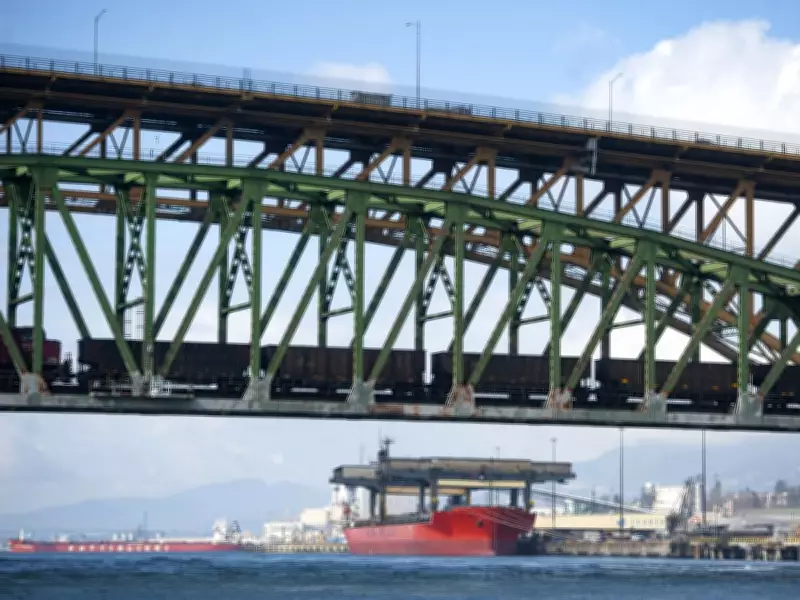
Vancouver's Aging Rail Bridge Failure Exposes Critical National Supply Chain Vulnerability
The recent mechanical failure of Vancouver's Second Narrows Rail Bridge has sent shockwaves through Canada's economic landscape, revealing just how precarious the nation's critical infrastructure has become. When the bridge jammed last week, marine traffic in Burrard Inlet came to a complete standstill, while farmers across Western Canada watched with growing anxiety as billions of dollars in trade hung in the balance.
A Single Point of Failure With National Consequences
The malfunction left the bridge's center span stuck in the lowered position, effectively blocking vessels from reaching terminals along the inlet. While rail traffic was largely spared, marine operations ground to a halt, demonstrating how a single aging piece of infrastructure—opened in 1969—can threaten access to Canada's largest port. The incident served as a stark warning that the Port of Vancouver remains just one breakdown away from economic chaos.
For grain farmers across the Prairie provinces, reliability is absolutely everything. When shipments slow or stop, contracts are lost and international customers begin looking elsewhere—to competitors in the United States, Australia, or the Black Sea region. Regaining that business proves far more difficult than losing it, meaning Canada's competitive advantage rests not just on crop quality, but on dependable delivery systems.

Growing Calls for Infrastructure Replacement
Agricultural organizations have been sounding alarms about this vulnerability for years. Both the Grain Growers of Canada and the Wheat Growers Association have specifically called for the bridge's replacement within the past year, yet their warnings have largely gone unheeded. Port leadership has instead focused attention on container expansion, even as bulk commodities—including grain—continue to represent significant portions of trade volumes.
The numbers tell a compelling story. Approximately 66% of the Port of Vancouver's bulk exports originate in Alberta, Saskatchewan, and Manitoba. Grain alone accounts for roughly $35 million in daily shipments moving through the port, with volumes increasing by 8% in the first half of 2025 and expected to continue growing. The Prairie provinces are not peripheral players in the Port of Vancouver's success; they are absolutely central to it.
Governance and Representation Challenges
Despite this economic reality, Prairie representation on the port's 11-member board remains limited to just a single member. Board appointments are made in Ottawa and frequently reflect political considerations rather than deep industry expertise. To encourage a broader, supply-chain-wide perspective, Prairie premiers have asked the federal government to reconfigure the board to include two members from each of the four western provinces—a proposal that would better reflect input from the region generating most of the port's trade.
So far, there has been no meaningful reform, even as Canada's seaport performance continues to decline. Last year, the Port of Vancouver fell to 398th out of 403 ports listed in the World Bank's Container Port Performance Index, with no Canadian port cracking the top 100. For an export-dependent nation, this represents more than an embarrassment—it constitutes a serious competitive liability.
Rising Costs and Competitive Pressures
Meanwhile, grain shippers face increasing financial pressures. The "Gateway Infrastructure Fee" introduced by the Port of Vancouver in 2023 added up to 40 cents per tonne, prompting a lawsuit from major grain terminal operators. Both Manitoba and Saskatchewan intervened in the case, with Saskatchewan's justice minister arguing that high fees could "diminish Canada's overall competitiveness."
Every additional cost reverberates throughout the supply chain, from farm to elevator to export vessel. As one expert noted, "ambition does not move grain to market—modern infrastructure, accountable governance, and investment decisions rooted in economic reality do." Replacing the aging Second Narrows Bridge would represent a crucial starting point for addressing these systemic challenges.

The recent bridge malfunction serves as a wake-up call for policymakers, industry leaders, and all Canadians who depend on reliable trade networks. Without urgent action to modernize critical infrastructure and reform governance structures, Canada risks losing its hard-earned reputation as a dependable global supplier.