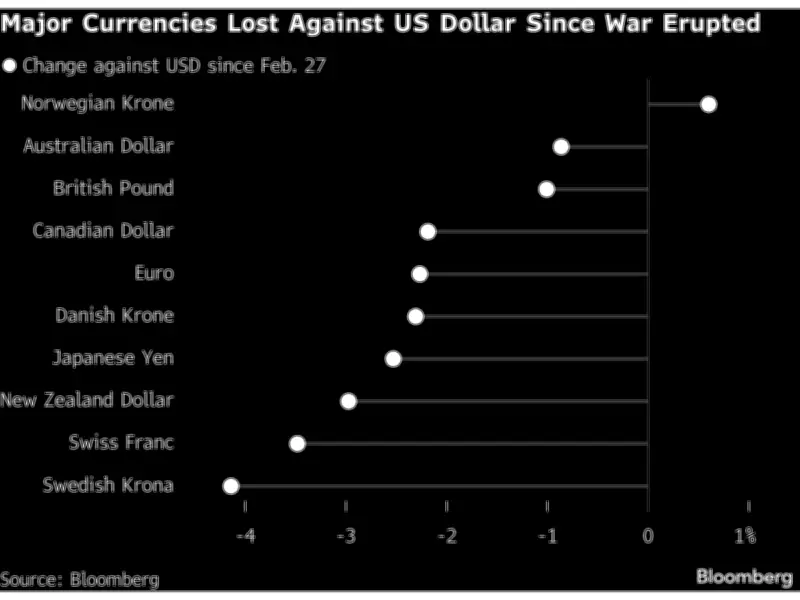
Betting on continued United States dollar strength is the cleanest way for foreign-exchange traders to take a position on a new regime of higher rates and inflation, according to BMO Capital Markets.
Market Dynamics and the Dollar's Appeal
Traders in the US$9.5 trillion-a-day foreign exchange market are "too eager" to price in the U.S.-Iran war resolution, Mark McCormick, BMO's chief FX strategist, wrote in a note on Monday. Oil prices may retreat after the conflict ends, but the inflationary effects will linger, fuelling higher rates globally and slower economic growth, which favours the U.S. currency, he said.
"Even if oil retreats at the margin — a big if — inflation is unlikely to fall as quickly; second-round effects are building, and correlations are shifting in ways that increasingly favour higher rates and a stronger dollar over headline optimism," McCormick said.

BMO's Positioning and Currency Outlook
BMO is staying broadly long on the dollar, especially against the euro, British pound and yen. McMormick's team also expects the dollar to strengthen against the Australian and Canadian dollars.
A dollar gauge advanced about two per cent since the U.S. and Israel started bombing Iran in late February. Though the war has upended global energy flows and hurt oil importing countries, the U.S. has weathered the higher energy prices and reported strong economic data. Traders have fully priced in a Federal Reserve interest-rate hike by the end of this year after May U.S. job growth topped all forecasts.
Recent Market Movements
The Bloomberg Dollar Spot Index had the best day in more than two months on Friday after the jobs report, and U.S. two-year yields, which are most sensitive to changes in U.S. central bank expectations, had the biggest one-day rise since President Donald Trump levied tariffs on most of the U.S.'s trading partners in April last year. The index edged lower on Monday after posting 1.1 per cent gains in the week prior.
Inflation Trends and Data
Consumer prices have been accelerating globally and in the U.S. Euro-area inflation topped three per cent for the first time since 2023 in May, cementing a case for rate hikes, even though the region's economy is struggling. The U.S. will issue May's inflation data on Wednesday, and the median estimate for the annual rate is for an increase of 4.2 per cent in May, up from 3.8 per cent in the previous month.
"We think higher rates, weaker growth, and wider macro dispersion remain the more durable story — and that should continue to favour the dollar, and the outperformance of U.S. assets, in this evolving regime," McCormick said. "Headlines are noise; regime is the signal."
Strategist Commentary
"Fed rate-hike bets look stickier given the U.S. economy's resilience in the face of elevated crude prices. That's supporting expectations for a higher neutral rate and rising inflation in the months ahead, which will help the dollar shake off its geopolitical hangover," said Tatiana Darie, Macro Strategist, Markets Live.