Ancient Mathematical Tool May Illuminate Path Through S&P 500's Steep Decline
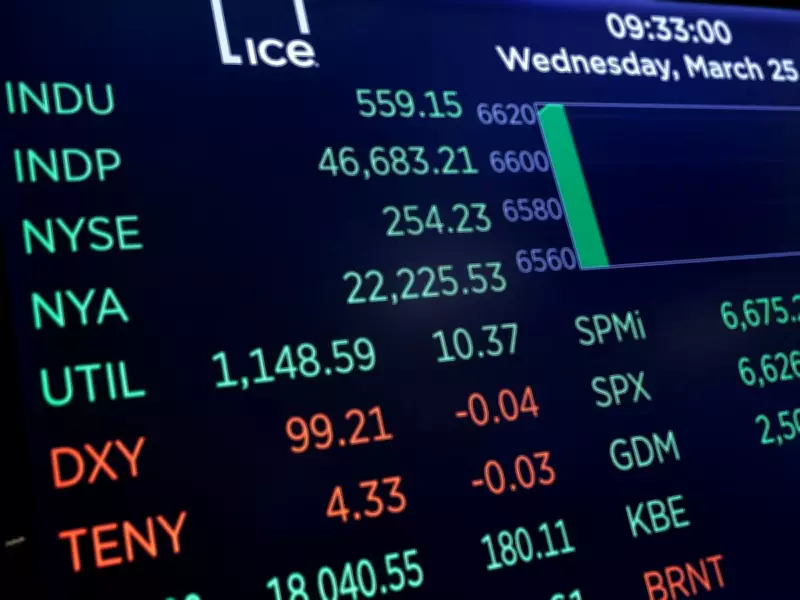
As the S&P 500 index endures four consecutive weeks of losses and heads toward its most challenging month in twelve months, equity traders are increasingly looking to an 800-year-old mathematical principle for guidance. This technical analysis tool, known as the Fibonacci retracement, has historically helped identify market bottoms during significant declines, including major routs since 2020. However, current signals indicate that bulls may face a prolonged downward trajectory before the index finds substantial support.
The 50 Percent Fibonacci Retracement Level Explained
The specific tool in focus is the 50 percent Fibonacci retracement level, a charting technique used by market analysts to pinpoint potential entry points based on ancient mathematical sequences. In the current context, this level represents a decline that would erase half of the S&P 500's gains from its low in April of last year to its record high in January. This critical threshold sits at 5,980, approximately nine percent below Wednesday's closing value, suggesting significant room for further downward movement.
Matt Maley, chief market strategist at Miller Tabak + Co., emphasized the importance of this level, stating, "When you get a clear change in trend, there are certain levels that investors look at to re-enter, especially shorter-term traders. That 50 percent retracement is one that people follow very closely."

Technical Analysis as One Piece of the Puzzle
While technical analysis provides valuable insights into stock-market trends and potential inflection points, experts caution that it is not a foolproof predictor. The S&P 500 recently dipped below 6,500 and is trading beneath its 200-day moving average, a trend line many hoped would halt the decline. Its failure to provide support has forced analysts to search for other potential bottom levels.
Doug Peta, U.S. investment strategist at BCA Research, noted, "It's easy to see from a technical perspective that the worst isn't over yet. Until the Strait of Hormuz is open and energy products are moving through it normally, there's likely to be upward pressure on inflation and downward pressure on global growth."
Maley further elaborated in a client note that if losses continue this week, the S&P 500 could move toward 6,200, with the next potential support at 5,980. This level not only marks the 50 percent Fibonacci retracement but also aligns with the index's mid-June low, adding to its significance.
Historical Precedents and Current Market Weakness
The Fibonacci sequence, named after Italian mathematician Leonardo Pisano (Fibonacci), proved useful during last year's market turmoil triggered by tariff announcements. The S&P 500 found support at 4,982.77, corresponding to the midpoint of a three-year rally from 2022. Similarly, the 2022 bear market reached its trough near the 50 percent retracement of the rally between March 2020 and early January 2022.
Jonathan Krinsky, chief market technician at BTIG LLC, pointed out that signs of stock-market weakness were evident before recent geopolitical conflicts, with issues in software and private credit already taking a toll. Regarding the effectiveness of the 50 percent retracement level in calling a bottom, Krinsky described it as "one piece of the puzzle." Maley concurred, noting that other market influences must align for it to be truly effective.
As traders navigate this volatile landscape, the ancient Fibonacci principle offers a historical lens through which to view potential market bottoms, though its application requires careful consideration of broader economic and geopolitical factors.