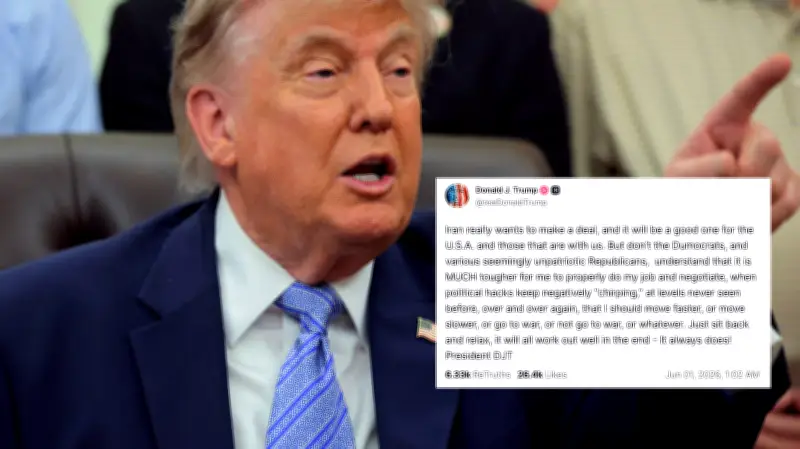
President Donald Trump's early morning Truth Social post urging Americans to 'just sit back and relax' amid escalating tensions with Iran may have the opposite effect, according to mental health experts. In a 1 a.m. message, Trump dismissed critics as 'chirping' and assured that 'it will all work out well in the end.' However, psychologists explain that telling someone to relax when they are stressed often increases anxiety rather than reducing it.
Why 'Just Relax' Doesn't Work
Kristen Gingrich, a licensed clinical social worker in Maine, told HuffPost that phrases like 'just relax' or 'calm down' are often intended to be reassuring but can backfire. 'They can unintentionally communicate that the person’s emotional reaction is the problem rather than the situation causing the distress,' she said. Ryan Martin, a psychology professor known as the Anger Professor, previously stated on the 'Am I Doing It Wrong?' podcast that 'no, relax has never relaxed anyone.'
The Problem with Dismissing Emotions
When people are anxious, overwhelmed, or scared, they typically seek understanding and acknowledgment first. Being told how to feel can make them feel dismissed or minimized, which often escalates their reactions. 'Instead of feeling supported, they may feel pressured to justify why they’re upset,' Gingrich explained. This is especially problematic when the person telling them to relax is the source of their anxiety, as in the case of President Trump.

Better Ways to Respond
Instead of saying 'just relax,' Gingrich recommends phrases like 'I can see why you’re upset' or 'this sounds really overwhelming.' Validating someone's feelings—without necessarily agreeing with their conclusions—can help de-escalate emotions. 'Validation does not mean agreeing with every thought... it simply means acknowledging that the person’s feelings make sense given what they are experiencing,' she said. In reality, people often become calmer when they feel genuinely understood.
While these insights are useful for everyday interactions, they also apply to leaders. Trump's attempt to quell dissent by telling Americans to relax may have inadvertently increased stress and criticism, highlighting the importance of empathetic communication in times of crisis.