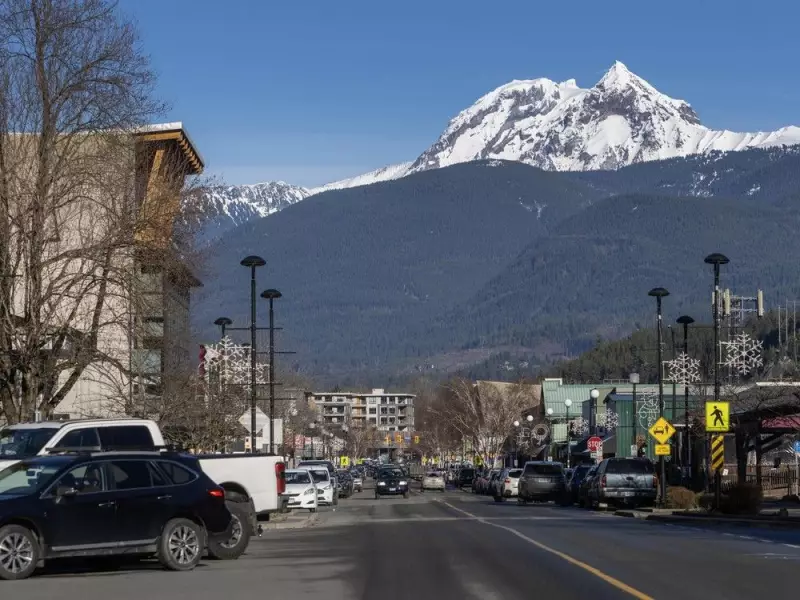
While a broad downturn characterized the Lower Mainland's real estate market in 2026, a handful of smaller communities bucked the trend, with Squamish leading the charge by posting gains across every housing category. Industry experts point to a powerful shift towards lifestyle and the enduring legacy of remote work as key drivers behind this resilience.
Squamish Transforms into a High-End Market
Local Realtor Lisa Bjornson, managing broker of Black Tusk Realty, highlights the dramatic transformation. "Five years ago, a sale over $2 million was an anomaly," she said. "Now, it's a established segment of our market." In 2025, the District of Squamish recorded 37 home sales exceeding $2 million, including four that surpassed the $3 million mark.
The current listing of a four-bedroom, 3,979-square-foot home for $6.85 million exemplifies this new reality. Bjornson, a 40-year resident who witnessed the town's evolution from a logging community, notes that such a property was once unimaginable. "That’s a West Vancouver build, that’s a Whistler build … It speaks to how people feel about the community now," she said. "We’ve come into our own."

Lifestyle and Remote Work Fuel Demand
The appeal is clear: Squamish's population has surged by nearly 50% in a decade, reaching approximately 28,000 residents. This growth isn't driven by bargain hunting. According to 2026 B.C. Assessment data, the median value for condos and townhouses in Squamish is $848,000—higher than in both the City of Vancouver and the City of North Vancouver.
"It’s about lifestyle," Bjornson emphasized. "People want to be here." Jeff Tisdale, CEO of Landcor Data Corp., suggests the rise of remote work is a significant factor enabling this migration to communities offering superior quality of life without a traditional commute to a major urban core.
Smaller Markets Stand Out Amid Regional Decline
Analysis of the 2026 B.C. Assessment data reveals a general cooling across the region. In major markets like Vancouver, Surrey, and Richmond, median values declined for all housing types, including strata units with one, two, or three-plus bedrooms.
However, a few outliers emerged:
- Squamish was the sole jurisdiction of 32 in the Lower Mainland to see year-over-year increases in median values for detached houses, attached units (like townhouses), and condominiums.
- The Village of Anmore (population ~2,600) saw a 4% increase in detached home values.
- Bowen Island (population ~4,700) recorded a 2.3% rise in the median value for attached properties, while most other municipalities saw declines, including drops of 5.8% in Richmond and 5.5% in Surrey.
This data underscores a fragmented market where specific, lifestyle-oriented communities continue to attract investment and demand, even as the broader regional trend points downward. The shift signifies a lasting change in how British Columbians prioritize their living environment, with smaller markets reaping the benefits.