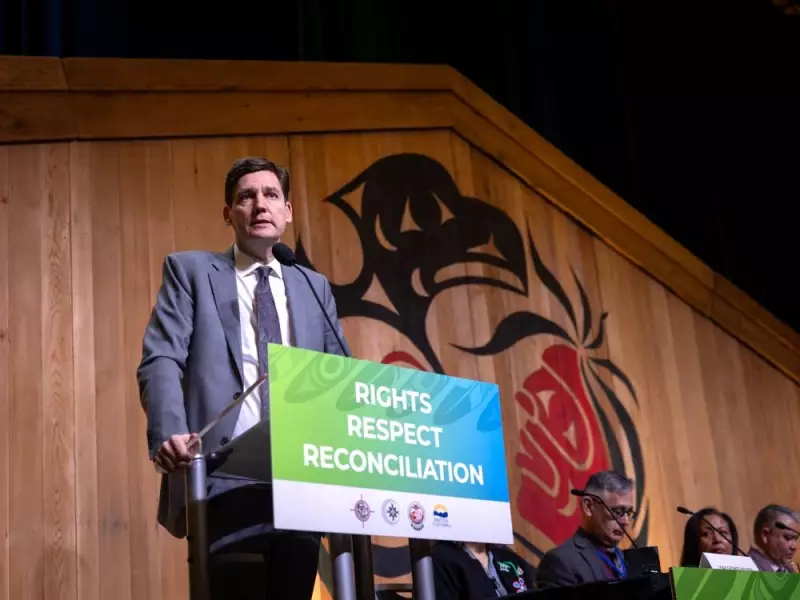
The government of British Columbia Premier David Eby is confronting a profound legal and economic challenge following two landmark court rulings that experts warn have placed private property rights across the province on unstable ground.
Court Decisions Shake Foundation of Land Ownership
In August 2025, the B.C. Supreme Court delivered the Cowichan Tribes decision, which declared titles to specific properties in the City of Richmond to be "defective and invalid." This ruling alone sent shockwaves through the real estate and legal communities.
Compounding the issue, the B.C. Court of Appeal ruled in Gitxaala v. British Columbia (Chief Gold Commissioner). This decision established that every law and regulation in the province must now align with the United Nations Declaration on the Rights of Indigenous Peoples (UNDRIP). UNDRIP explicitly emphasizes the rights of Indigenous peoples to their lands, territories, and resources.

Legal analysts interpret the combined effect as elevating UNDRIP to a constitutional-level framework within B.C., creating a new and complex layer for property law.
Government Response and Escalating Concerns
Facing intense pressure, Premier Eby recently vowed to "go to the wall" to protect the rights of affected property owners in Richmond. The province is reportedly considering interim measures like government loan guarantees for homeowners who may struggle to refinance mortgages or secure financing for sales due to clouded titles.
However, critics argue these are temporary fixes that fail to address the systemic issue. The core problem extends far beyond a few properties in Richmond. Most of British Columbia is not covered by modern treaties, meaning similar land claims and title challenges could emerge across the province, potentially placing countless property owners in legal limbo.
A Threat to Economic and Democratic Foundations
The stakes are argued to be monumental. Secure, private property held in fee simple is widely regarded as the bedrock of a modern market economy and a high standard of living. It provides the certainty needed for investment, development, and wealth creation.
Renowned Peruvian economist Hernando de Soto has extensively documented how formal, secure property rights are a critical catalyst for prosperity. In his seminal work, he posited that the lack of such systems is a primary barrier to development in many countries. Formal title transforms assets into usable capital, provides protection from fraud, and grants individuals indisputable proof of ownership.
Beyond economics, property rights are intrinsically linked to fundamental freedoms. The security of one's home and livelihood underpins the ability to speak freely and participate in democracy without fear of retribution through asset seizure. Nations that score highest on global freedom indices consistently feature strong, legally protected private property rights.
The situation in British Columbia now presents a pivotal test: can the province reconcile the imperative of implementing UNDRIP with the need to maintain the legal certainty of private property that has underpinned its economy for generations? The answer will have profound consequences for homeowners, investors, and the province's financial future.