Maxus Mining Continues to Deliver Strong Polymetallic Results at Quarry Antimony Property in British Columbia
VANCOUVER, British Columbia – Maxus Mining Inc. has announced significant analytical results from its 2025 field program at the Quarry Antimony Property, located in the Omineca Mining District of British Columbia, Canada. The company engaged Palliser Exploration Ltd. to conduct a comprehensive reconnaissance field program across the project during autumn 2025, with the second batch of sample results now available.
2025 Field Program Highlights
The recent exploration results confirm the strong polymetallic signature previously identified on the property, with multiple outcrop and grab samples returning notable anomalous values for silver, zinc, and lead, alongside associated antimony mineralization.
Rock Sample Assay Highlights Include:

- Sample G019851: 60.8 g/t silver, 3.36% zinc, 4.09% lead
- Sample G019857: 23.7 g/t silver, 10.5% zinc, 1.92% lead
Previously Reported Rock Sample Assay Highlights:
- Sample G019834: 234 g/t silver, 110 ppm antimony, 0.46% zinc, 4.67% lead
- Sample G019827: 121 g/t silver, 67 ppm antimony, 0.74% zinc, 2.35% lead
- Sample G019831: 52.1 g/t silver, 68 ppm antimony, 9.62% zinc, 0.75% lead
- Sample G019828: 11.1 g/t silver, 2.83% zinc, 0.36% lead
- Sample G019854: 10.5 g/t silver, 4.39% zinc, 2.38% lead
- Sample G019833: 9.4 g/t silver, 4.86% zinc, 0.597% lead
- Sample G019853: 7.1 g/t silver, 2.39% zinc, 0.26% lead
Extension of Mineralization and Strategic Location
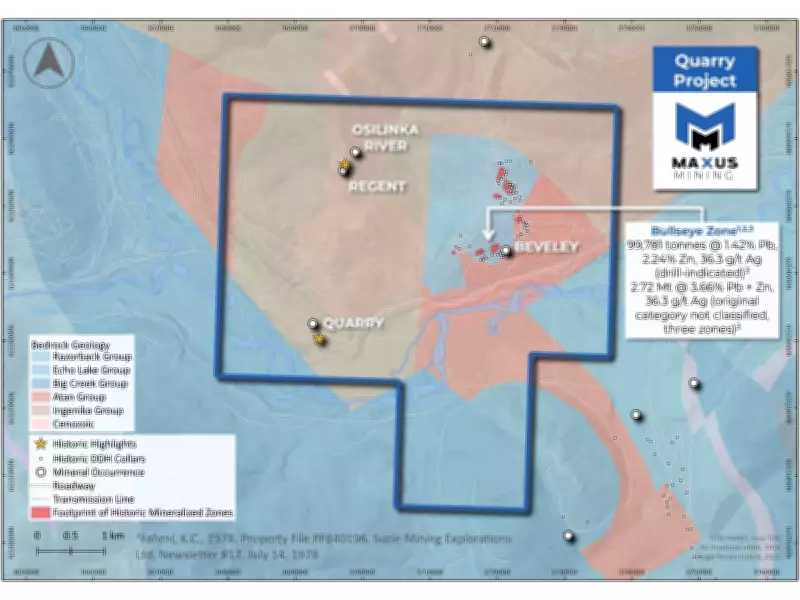
The 2025 grab samples have successfully extended the footprint of polymetallic mineralization in the northeast corner of the project, now covering over 350 metres in strike length. This expansion demonstrates the growing scale potential of the mineralized system.
The Quarry Antimony Property is strategically positioned approximately twenty-eight kilometers northwest of Germansen Landing, British Columbia. The area features favorable carbonate and dolomite breccia host rocks that are considered highly prospective for polymetallic mineralization, enhancing the project's geological appeal.
Historical Context and Project Significance
Historical sampling from the 1990s revealed assays of 0.89 g/t gold, 3.8% copper, 0.34% zinc, 42.5% lead, 0.65 g/t silver, and 20% antimony. Even earlier, 1954 grab samples yielded impressive averages of 83.5% lead and 1,576 g/t silver, indicating the long-standing mineral potential of the area.
Historical estimates for the Bullseye Zone, though non-compliant with NI 43-101 standards, include 99,781 tonnes at 1.42% lead, 2.24% zinc, and 36.3 g/t silver (drill-indicated), along with 22.72 million tonnes at 3.66% lead plus zinc and 36.3 g/t silver across three zones.
Executive Commentary
"The results from this second phase of sampling at the Project build directly on our initial findings and continue to demonstrate the strength and consistency of the polymetallic system," stated Scott Walters, Chief Executive Officer of Maxus Mining Inc.
"We are particularly encouraged by the extension of mineralization along a defined structural trend at the Bullseye Zone, which highlights the growing scale potential at the Project. These outcomes are helping to refine our understanding of the system and will guide the next phase of targeted exploration."
The company's ongoing exploration efforts at the Quarry Antimony Property continue to validate the property's potential as a significant polymetallic resource in British Columbia's mineral-rich landscape.