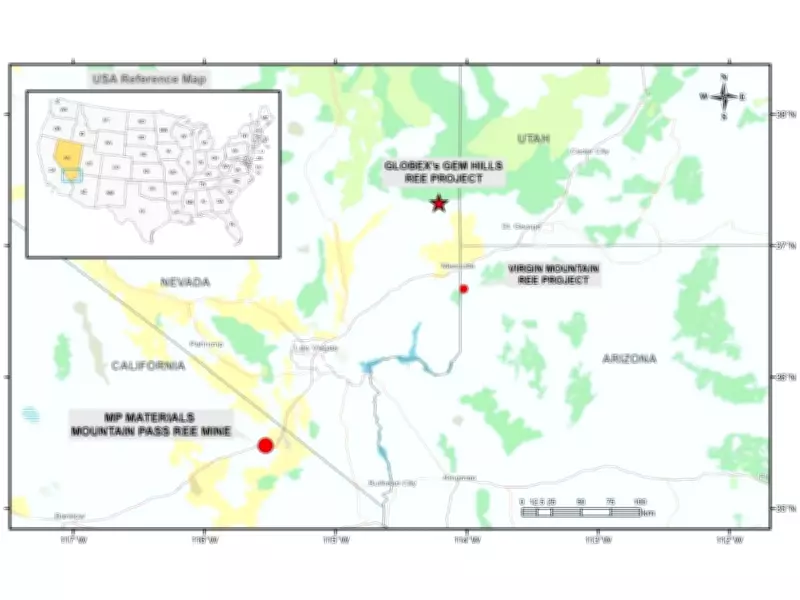
Globex Mining Enterprises Inc. has made a significant discovery of rare earth mineralization at its newly acquired Gem Hills Property in southeastern Nevada, marking a potential development in domestic rare earth supply chains for the United States.
Strategic Acquisition and Initial Findings
The Toronto-based mining company, trading under symbols GMX on the Toronto Stock Exchange and GLBXF on OTCQX International, announced on February 11, 2026, that it has acquired through its subsidiary Globex Nevada a contiguous block of unpatented lode mining claims in Lincoln County, Nevada. The property is located approximately 170 kilometers northeast of Las Vegas and was acquired through staking procedures.
Simultaneously with the acquisition, Globex completed an initial prospecting and sampling program that yielded promising results. The company reported that sampling returned significantly high-grade rare earth oxide values, with assays showing between 0.28% and 5.26% total rare earth oxides, averaging approximately 1.7% TREO.

Mineralization Characteristics and Potential
The mineralization identified at Gem Hills demonstrates several notable characteristics that suggest economic potential. The samples contained up to 18.97% heavy rare earth oxides and 35% neodymium oxide plus praseodymium oxide, both of which are particularly valuable for high-tech and defense applications.
According to Globex, the rare earth mineralization shows an exposed strike length of at least 90 meters along a northeast-oriented segment, with potential extension of approximately 40 meters to the west. The mineralization remains open to both the north and south, though it is currently concealed under overburden in those directions.
The sampling results were characterized by high-grade total rare earth oxides and local enrichment of the more valuable heavy rare earth elements, which are critical for numerous modern technologies including electric vehicles, wind turbines, and defense systems.
Geological Context and Historical Background
The Gem Hills Property is situated at the southeastern margin of the Caliente Caldera Complex within the Great Basin geological province. The area features felsic and intermediate calc-alkaline volcanic rocks that erupted between 24 and 18 million years ago during the Late Oligocene to Early Miocene periods.
Globex first discovered rare earth element mineralization in the area during a regional prospecting campaign in 2024. The property lies outside any known mining district, though several small historic prospects and two shallow shafts dating back to the 1930s and early 1940s exist in the area. These historical workings explored and mined small-scale limonite and manganese oxides, not rare earth elements.
In 2024, Globex collected 13 surface rock samples within and near the Gem Hills property. The company expanded its sampling efforts in late 2025, collecting a total of 39 rock samples, including 34 from within the property boundaries. This included 17 channel samples taken from seven hand-dug trenches, prospect dumps, and rock outcrops.
Regional Significance and Strategic Implications
The Gem Hills discovery occurs within a region that is becoming increasingly important for rare earth production in the United States. The property is located relatively near MP Materials' Mountain Pass rare earth mine, which accounts for approximately 12% to 14% of global rare earth mined output, primarily light rare earth elements.
The U.S. government, particularly through the Department of Defense, has provided significant support to MP Materials' operations, including a major 2025 loan for heavy rare earth separation, grants for processing upgrades, and price-floor agreements for neodymium and praseodymium. These initiatives aim to secure domestic supply chains for defense and high-tech industries, reduce reliance on Chinese rare earth exports, and enhance U.S. industrial independence.
The discovery at Gem Hills represents another potential source of rare earth elements within the United States, which could contribute to these strategic objectives. The property's location in Nevada, a mining-friendly jurisdiction with established infrastructure, adds to its potential viability.

Future Exploration and Development Potential
While the initial sampling results are promising, significant work remains to fully understand the extent and economic potential of the Gem Hills mineralization. The fact that the mineralization is open in multiple directions suggests potential for expansion through further exploration.
The geological setting, with isolated windows of Lower Paleozoic carbonate rocks surrounded by volcanic rocks from the Caliente Caldera, presents interesting possibilities for mineralization. Additionally, isolated small intrusive stocks or plutons of mostly Tertiary age appear locally at the margin of the Caliente Caldera Complex, which could influence mineralization patterns.
Globex's discovery comes at a time of increasing global demand for rare earth elements, particularly those critical for green energy technologies and advanced electronics. The company's initial findings at Gem Hills suggest it may have identified a potentially significant rare earth resource that warrants further investigation and development.