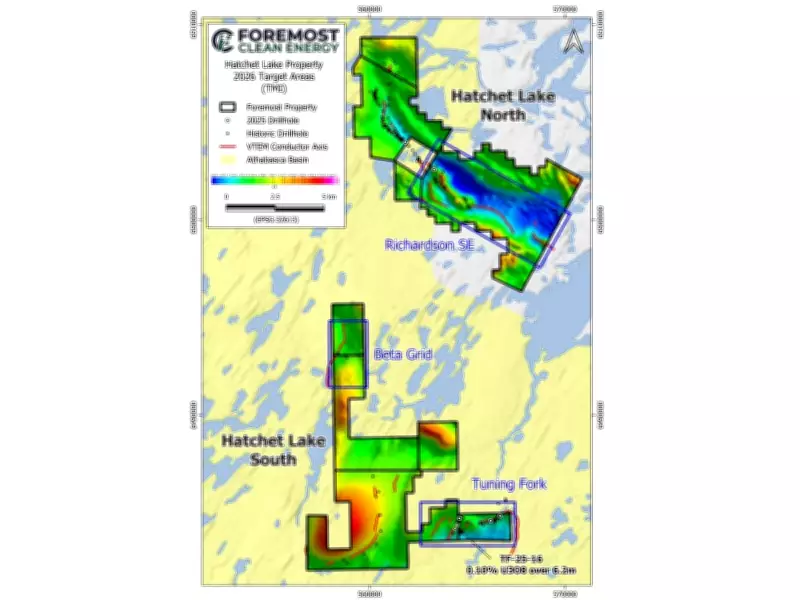
VANCOUVER, British Columbia – Foremost Clean Energy Ltd. (NASDAQ: FMST, CSE: FAT) has officially commenced its planned winter diamond drill program at the Hatchet Lake Uranium Project, located in the eastern Athabasca Basin region of northern Saskatchewan. The program, which involves approximately 5,000 metres of drilling, is currently underway at the Tuning Fork target area, following up on the company's 2025 uranium discovery.
Building on 2025 Discovery
The drilling initiative is designed to test the along-strike and down-dip continuity of mineralization, refine structural controls on uranium emplacement, and evaluate additional high-priority targets across both Hatchet Lake South and Hatchet Lake North. This follows the significant 2025 discovery in drill hole TF-25-16, which intersected 0.87% U₃O₈ over 0.45 metres within a broader 6.2-metre interval averaging 0.10% U₃O₈ at the Athabasca unconformity.
CEO Comments on Program Objectives
Jason Barnard, President and CEO of Foremost, expressed enthusiasm about the program's launch. "We are pleased to confirm that drilling is now underway at Hatchet Lake as we advance the Tuning Fork discovery," Barnard stated. "This program is designed to build on the 2025 results by systematically testing continuity of mineralization at the Athabasca unconformity and refining the structural and alteration framework controlling uranium mineralization. With multiple drill-ready targets defined across the property, we look forward to executing a focused and results-driven winter campaign."

Program Overview and Target Areas
The Hatchet Lake Project consists of two claim blocks that contain conductive corridors and structurally complex zones prospective for unconformity-related uranium mineralization. Drill targets were prioritized using historical drilling and geophysical datasets from Denison Mines Corp., refined through Foremost's updated interpretation and conductor modelling to enhance target geometry ahead of drilling.
Tuning Fork Target Area
Initial drilling efforts are concentrated within the Tuning Fork target area, where the 2025 discovery was made in a previously untested 600-metre gap between historic drill holes. The current phase aims to:
- Test along-strike and down-dip continuity of mineralization
- Refine structural controls associated with uranium mineralization at the Athabasca unconformity
- Test a recently identified electromagnetic conductor to the west of the 2025 uranium discovery
Additional High-Priority Targets
Subject to progress at Tuning Fork, the program is expected to test additional drill-ready targets at both Hatchet Lake South and Hatchet Lake North. At Hatchet Lake South, the Beta Grid represents a structurally controlled target characterized by interpreted displacement of the Athabasca unconformity associated with a conductive corridor. Such structural disruption is widely recognized as a key control on uranium mineralization within the Athabasca Basin.
At Hatchet Lake North, the Richardson SE target encompasses more than five kilometres of untested electromagnetic conductor strike length along the Basin margin. Recent ground gravity survey results are being integrated with existing datasets to refine drill targeting, with a focus on identifying zones of structural complexity and hydrothermal alteration.
Strategic Importance and Future Outlook
The 2026 winter drill program represents a critical step in Foremost Clean Energy's ongoing exploration efforts in one of the world's most prolific uranium regions. The Athabasca Basin is renowned for hosting high-grade uranium deposits, and the Hatchet Lake Project's strategic location positions the company to potentially expand its resource base through systematic exploration.
As drilling progresses throughout the winter season, stakeholders and investors will be watching closely for results that could further validate the project's potential and inform future exploration decisions. The program's success could have significant implications for Foremost's position in the clean energy sector, particularly as global demand for uranium continues to grow amid shifting energy policies worldwide.