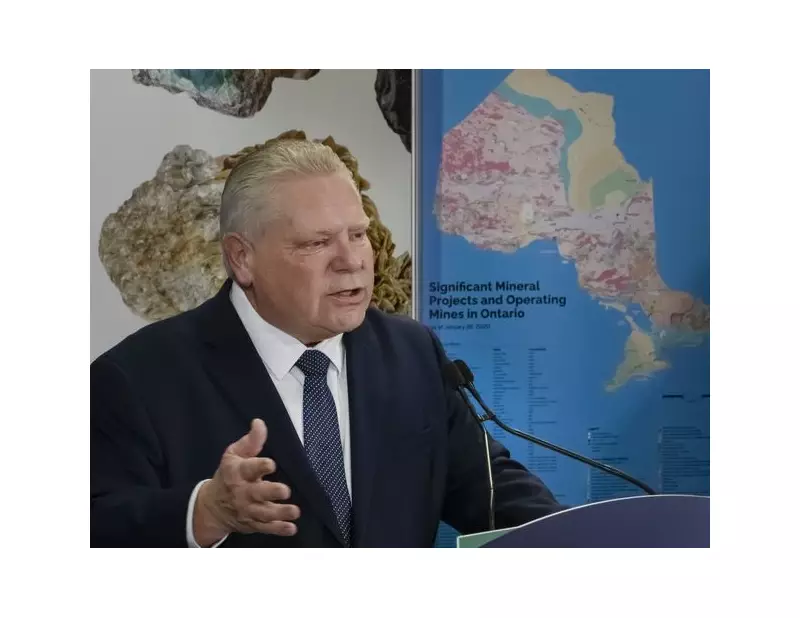
The federal and Ontario governments are poised to sign a landmark agreement this week designed to slash regulatory hurdles for major infrastructure and mining projects, with a key focus on the long-awaited road access to the mineral-rich Ring of Fire in Northern Ontario.
A "One Project, One Review" Approach
Prime Minister Mark Carney and Ontario Premier Doug Ford will formalize the deal at a ceremony in Ottawa on Thursday, December 18, 2025. The agreement, confirmed by government sources not authorized to speak publicly, commits both levels of government to a "One Project, One Review and One Decision" framework. The core objective is to eliminate duplicative environmental impact assessments, a move hailed as transformative for project timelines.
A source within Premier Ford's office emphasized the scale of the change, stating it will "dramatically speed up big projects across the province, including roads, highways and mines." The source added, "It will be 10 times more transformational than any major project." A senior federal source echoed this, clarifying that while duplication will be cut, stringent standards and protections for rights and the environment will be upheld.

Accelerating the Path to the Ring of Fire
A critical component of the deal is a side agreement specifically addressing the proposed roads to the Ring of Fire. The federal government has committed to aligning its impact assessment timeline with the province's environmental assessment process for these projects. This is crucial for the Webequie First Nation and Marten Falls First Nation, who are leading assessments on three all-season roads and aim to begin construction in 2026.
These First Nations view the roads as vital infrastructure to connect their remote, fly-in communities to the provincial highway grid and future mining activities, offering a path to economic development. However, the plan faces opposition from other nearby First Nations concerned about regional environmental impacts.
As a result of this new cooperation, the Ontario government is no longer expected to use controversial powers to designate the Ring of Fire road corridor a special economic zone, which would have allowed it to suspend certain laws to speed up development.
Broader Impacts and Mineral Potential
The regulatory streamlining extends beyond the Ring of Fire. The pact will see Ottawa and Ontario collaborate on assessments for navigable waters, species at risk, and migratory birds—areas traditionally under federal jurisdiction.
The Ring of Fire region is believed to hold vast deposits of critical minerals essential for modern technology. Companies like Australian giant Wyloo and Canada's Juno Corp., which hold the majority of over 40,000 claims in the area, have identified deposits of nickel, copper, chromite, titanium, and platinum. These minerals are key components for batteries, semiconductors, stainless steel, and electronics. Wyloo is nearing completion of a feasibility study for its proposed Eagle's Nest underground mines.
This federal-provincial agreement marks a significant political and practical shift, aiming to balance economic development ambitions with environmental oversight by making the process more efficient, though not less rigorous, according to government assurances.