Collective Metals Announces Inaugural Drill Program at Rocas Uranium Project
Collective Metals Inc. (CSE: COMT | OTC: CLLMF | FSE: TO1) has officially announced finalized plans for the first-ever drill campaign at its Rocas Uranium Project, located in the eastern Athabasca Basin of Saskatchewan. This marks a significant milestone for the company as it prepares to test high-priority uranium targets in one of the world's premier uranium districts.
Drill Program Details and Funding
The Phase I drill program will consist of approximately 1,200 to 1,500 meters planned across six to eight drill holes. This inaugural campaign will target shallow, high-grade basement-hosted uranium mineralization, representing the first drilling activity in the project's history. The company has confirmed that it will fully fund 100% of the program to satisfy year-one expenditure requirements under the definitive property option agreement with Standard Uranium (Saskatchewan) Ltd. and Standard Uranium Ltd.
All key contracts for the program have been secured, with diamond drilling crews scheduled to mobilize to the project site as early as mid-March to begin preparations. The Rocas Project is strategically positioned approximately 75 kilometers southwest of the historical Key Lake Mine and currently active mill facilities along Highway 914.

Target Identification and Geological Support
High-priority uranium target areas have been identified through multiple exploration initiatives. The 2025 prospecting and mapping program revealed compelling surface results, including anomalous radioactivity readings of up to 33,000 counts-per-second (cps), with ten separate occurrences exceeding 10,000 cps. These findings complement geophysical anomalies identified during the 2024 high-resolution ground gravity survey conducted by MWH Geo-Surveys (Canada) Ltd.
The integration of these results with historical electromagnetic corridors and fault structures has significantly refined the company's drill targeting strategy. Geophysical target zones on the project are located approximately 100 to 200 meters below surface, making them accessible for shallow drilling operations.
Historical Context and Exploration Potential
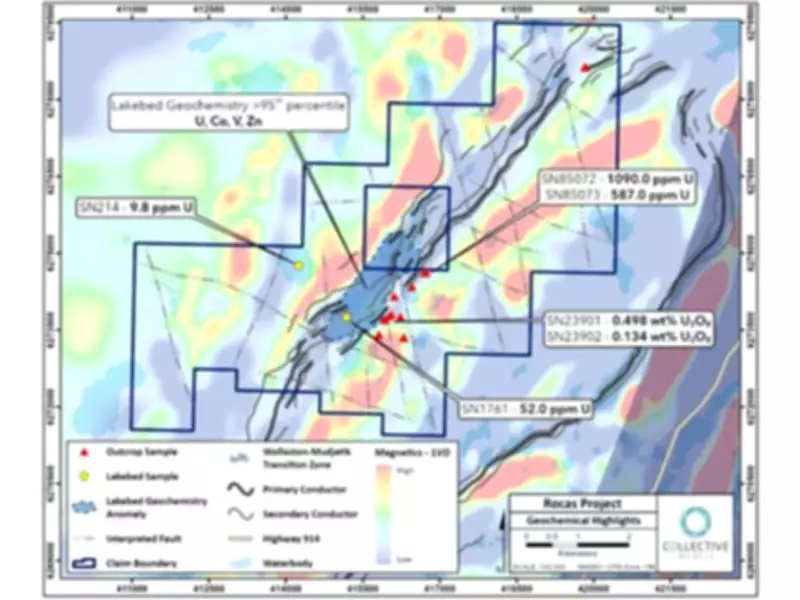
The Rocas Project sits along a 7.5-kilometer magnetic low/EM conductive corridor that hosts several uranium occurrences that have remained untested by drilling to date. Historical mineralized outcrop grab samples collected along approximately 900 meters of strike length have returned values ranging from 587 ppm uranium up to 0.498 weight percent U3O8, providing strong indications of mineralization potential.
Christopher Huggins, Chief Executive Officer of Collective Metals, commented on the development: "Finalizing our maiden drill program at Rocas marks a major milestone for Collective. With compelling surface results, strong geophysical support, and fully funded drilling, we are excited to begin testing shallow basement-hosted uranium targets in one of the world's premier uranium districts."
Technical Work and Data Integration
The 2024 gravity survey outlined several gravity-low anomalies that coincide with historical surface mineralization, lakebed geochemical anomalies, and cross-cutting fault zones along known conductive exploration trends. Convolutions Geoscience Corporation completed the processing, interpretation, and modeling of this gravity data, providing valuable insights for target prioritization.
The company plans to complete the drill program in the first quarter of 2026, focusing on testing high-priority zones along the main conductive corridor. Geochemical assay results from the 2025 prospecting program are currently pending and will provide additional data for ongoing exploration planning.