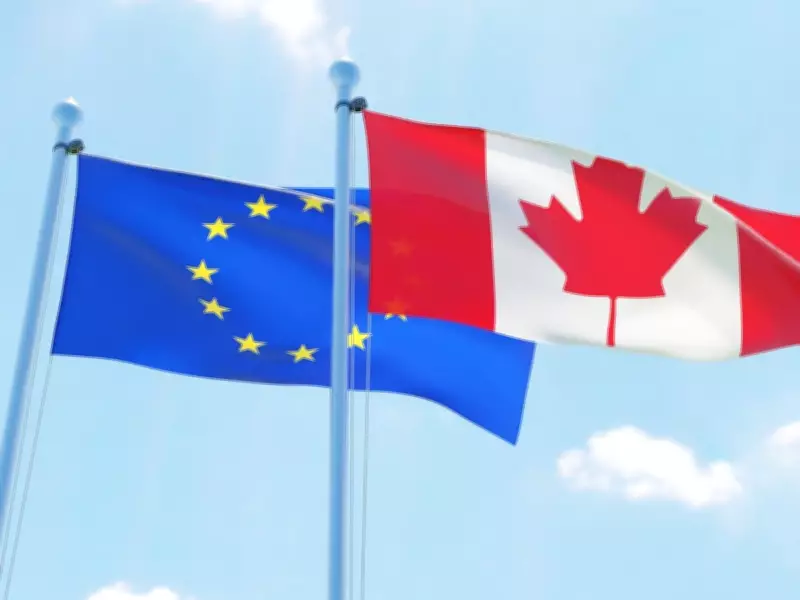
Why Canadian EU Membership Is a Fundamentally Flawed Proposition
A recent poll conducted by Spark Advocacy has revealed that 57% of Canadians believe it is "worth exploring" the idea of Canada joining the European Union. This sentiment appears to be driven by a desire to diversify trade relationships away from the United States, particularly following periods of trade tension under former U.S. President Donald Trump. However, a closer examination reveals that EU membership would represent one of the most complex and potentially destabilizing international agreements Canada could ever consider.
The Legal Barrier: A Non-European Nation Cannot Join
The most immediate obstacle to Canadian membership in the European Union is a legal one. Article 49 of the Treaty of the European Union explicitly states that membership is open only to "European States." This is not a minor technicality; it is a fundamental requirement that has been enforced consistently. For instance, when Morocco applied for EU membership in 1987, it was rejected outright because it is an African nation, not a European one.
For Canada to even be considered, the EU would need to amend its core treaty—a process that requires unanimous consent from all 27 member states. Even a single dissenting vote from a small nation like Luxembourg would be enough to block any such amendment. The notion that the EU would rewrite one of its foundational documents specifically for Canada is highly speculative and politically unrealistic.

Economic and Regulatory Implications
Beyond the legal hurdles, EU membership would impose significant economic and regulatory burdens on Canada. The European Union is not merely a trade pact; it is a supranational entity with extensive authority over member states. Joining would subject Canada to a vast array of EU regulations, affecting everything from agricultural standards to environmental policies.
Moreover, Canada would likely become a net contributor to the EU budget, similar to how wealthier provinces like Alberta contribute more to federal coffers than they receive in return. This dynamic is already a point of contention within Canada, and it would be magnified on an international scale. Canadian taxpayers could find themselves subsidizing EU programs with minimal direct benefit, straining public finances and potentially fueling domestic discontent.
Sovereignty and Political Influence
Another critical consideration is sovereignty. EU membership would require Canada to cede significant decision-making power to institutions in Brussels, where Canadian influence would be limited. As a non-European nation, Canada would have minimal representation in the EU's political structures, making it difficult to advocate for national interests effectively.
This loss of autonomy could impact key areas such as immigration policy, trade negotiations, and environmental regulations. Canadians would be subject to laws and directives crafted primarily for European contexts, which may not align with Canadian values or economic priorities.
Public Perception vs. Practical Reality
The poll results indicate a growing public interest in exploring alternatives to the U.S.-centric trade model. However, this enthusiasm may not be grounded in a full understanding of what EU membership entails. While diversifying trade partnerships is a legitimate goal, pursuing EU membership as a solution is fraught with legal, economic, and political challenges that make it an impractical option.
Instead, Canada might benefit from focusing on strengthening existing bilateral agreements with the EU and other global partners, rather than seeking full membership in a bloc that is geographically and culturally distinct. This approach would allow Canada to maintain its sovereignty while still expanding its international trade networks.
In summary, while the idea of Canadian EU membership may seem appealing on the surface, the practical realities—from legal barriers to economic costs and sovereignty concerns—render it a fundamentally flawed proposition. Canadians and policymakers alike should approach this issue with a clear-eyed understanding of the significant drawbacks involved.