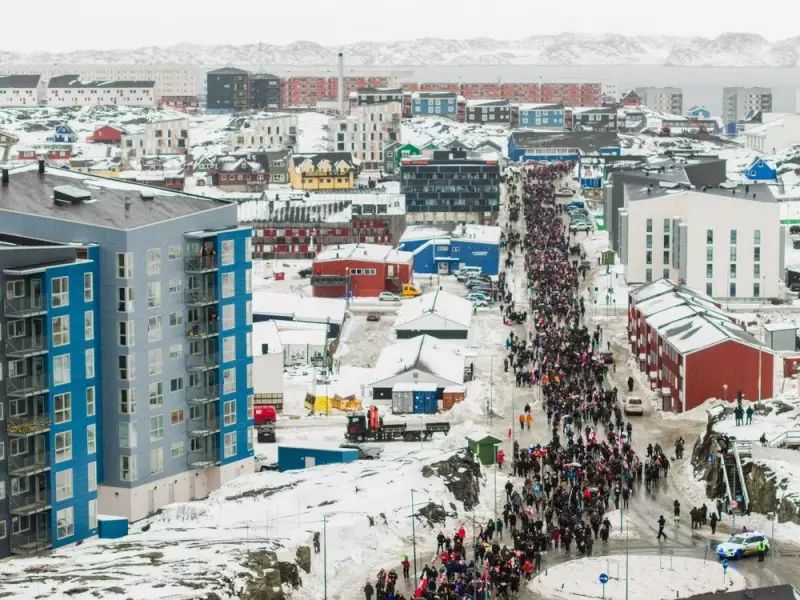
In a dramatic escalation of his long-standing ambition to acquire Greenland, former U.S. President Donald Trump has threatened to impose punitive tariffs on eight European nations that support Denmark's sovereignty over the Arctic territory. The announcement, made via social media on January 17, 2026, marks a significant new strain in transatlantic relations, targeting key members of the NATO alliance.
Tariff Threat and European Backlash
Trump declared his intention to levy a 10% tariff on goods from Denmark, Norway, Sweden, France, Germany, the United Kingdom, the Netherlands, and Finland, effective February 1, 2026. He further threatened to increase the levy to 25% in June if his demand for the "Complete and Total purchase of Greenland" is not met. The move directly challenges the unity of the European Union and the NATO alliance, of which Denmark is a founding member.
The threat coincided with thousands of protesters gathering in Nuuk, Greenland's capital, to voice opposition to any potential sale of the mineral-rich, strategically vital island. European leaders were swift and firm in their condemnation. Swedish Prime Minister Ulf Kristersson stated, "We will not allow ourselves to be blackmailed," emphasizing that the issue concerns the entire EU. European Council President Antonio Costa announced he is coordinating a joint EU response to what analysts are calling a hostile act.

Legal Uncertainties and Historical Context
Significant questions surround the legal authority Trump would use to enact these country-specific tariffs. The administration has previously relied on the International Emergency Economic Powers Act for similar trade threats, a use currently under review by the U.S. Supreme Court in a landmark case. An alternative mechanism, known as Section 122 powers, is limited to 15% tariffs for a maximum of 150 days, casting doubt on the longevity and feasibility of Trump's plan.
This latest provocation follows a week of high-stakes diplomacy in Washington, where Danish Foreign Minister Lars Lokke Rasmussen and Greenland's Foreign Minister Vivian Motzfeldt met with top U.S. officials and members of Congress. The Trump administration has been frustrated by the European Parliament's failure to ratify a July trade accord that already imposed a 15% tariff on most EU goods and 50% on steel and aluminum.
Broader Implications for Transatlantic Relations
Simone Tagliapietra, a senior researcher at the Bruegel think tank in Brussels, warned that "The Pandora’s box of tariffs has been reopened — and the stakes are higher, with an unprecedented level of brutality." He urged Europe to respond with strength, potentially utilizing its anti-coercion instruments. The situation places the involved European nations in an extraordinary position: facing economic punishment from a traditional ally seeking to annex territory within their political bloc.
The standoff over Greenland, which Trump has publicly coveted for its vast resources and geopolitical significance in the Arctic, now threatens to morph into a full-blown trade and diplomatic crisis. The coming weeks will test the cohesion of the European Union and the resilience of the post-war Atlantic alliance, as leaders grapple with an unprecedented attempt to leverage trade policy for territorial acquisition.