

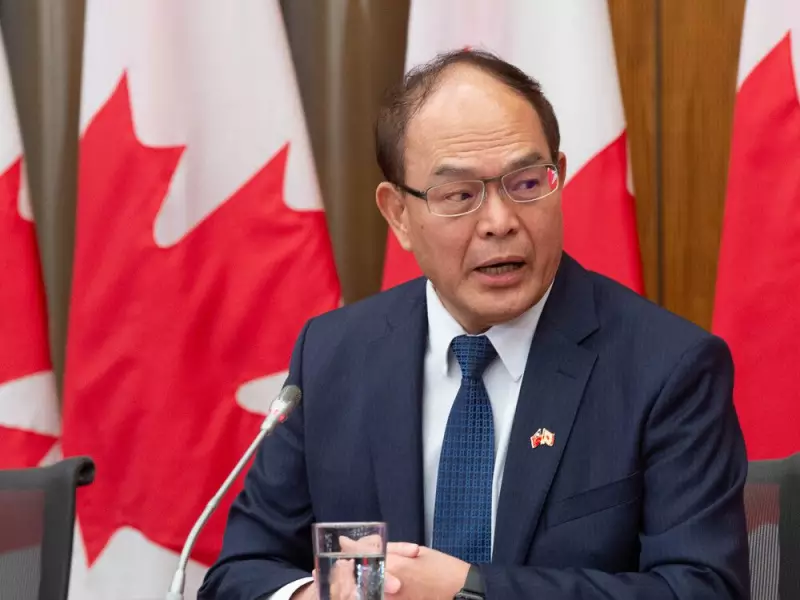
Taiwan's senior diplomat in Ottawa has publicly cautioned Canada against viewing China as a solution to its economic challenges, casting doubt on the reliability of Beijing as a trading partner. The comments from Representative Harry Ho-jen Tseng follow Prime Minister Mark Carney's recent agreement with Chinese leader Xi Jinping to lower bilateral trade barriers.
A Diplomatic Critique of the Beijing Reset
The Canadian and Chinese leaders finalized a deal last week aimed at rebuilding economic ties after years of strained relations. The agreement involves Canada opening its market to a limited number of Chinese electric vehicles at a reduced tariff, while China will lower import taxes on Canadian canola, a vital crop for Western farmers.
This pivot comes as Canada seeks to diversify its export markets, which are heavily dominated by the United States, especially in light of high tariffs imposed by U.S. President Donald Trump.

"You Can't Find an Answer in China"
In a pointed interview, Ho-jen Tseng expressed skepticism about the economic benefits of Canada's outreach to Beijing. "If this trip to China is genuinely looking for an economic remedy for Canada, I don't think you can find an answer in China," he stated. He suggested that if the mission was aimed at gaining political leverage, that was a separate matter.
The envoy, a former deputy foreign minister for Taiwan, argued that a free trade deal with China is "unachievable" because China is not a market economy. He highlighted the political nature of China's market expansions and contractions, noting that purchases from Canada would likely come from state-owned enterprises, not consumers. "The state can stop buying at any time," he warned, implying a lack of predictability.
Taiwan's Trade Role and Diplomatic Nuances
Ho-jen Tseng also addressed the recent shortening of a Canadian parliamentary trip to Taiwan, which was adjusted to avoid overlapping with Carney's visit to Beijing. He deemed the move "totally unnecessary," highlighting the delicate diplomatic balance Canada maintains.
Officially, Canada does not formally recognize Taiwan, adhering to a policy shared by many Western nations that neither challenges nor endorses China's claim over the self-governed island. Despite this, trade flourishes. In 2024, Taiwan was Canada's 15th-largest merchandise trading partner, with $6 billion in goods exchanged. Two-way services trade added another $1.9 billion.
The envoy praised Canada's 2022 Indo-Pacific Strategy, formulated under former Prime Minister Justin Trudeau, which labeled China an "increasingly disruptive global power." He called it a "very good road map." However, Foreign Minister Anita Anand recently indicated a potential shift, stating the Carney government has a new foreign policy for a new geopolitical environment. Officials from the Chinese embassy in Ottawa did not respond to requests for comment on the envoy's statements.






